Carry · Institutions of One × Fashion
Interpretation study · Garment → image → cultural proposition
How Stylists Manufacture Cultural Meaning
A stylist does not merely arrange clothes. Styling selects, relates, withholds, and frames objects so that a look can enter culture—yet interpretation, authorship, ownership, credit, approval, and compensation must remain separate evidence questions.
Read the story00
The proposition
The garment arrives with materials and a maker record, but it does not arrive with one inevitable meaning. Silhouette beside body, accessory beside setting, pose beside caption, and reference beside audience can convert the same object into glamour, refusal, nostalgia, status, parody, or evidence. FIT’s Styling for Creative Media program publicly describes stylists as creating visual brand and design concepts; that is authoritative evidence of an institutionalized role, not proof that every styling arrangement works the same way.
The Women of Harper’s Bazaar exhibition offers a second boundary: fashion imagery emerged through collaboration among editorial and photographic roles. The useful question is not who deserves the entire image. It is which person made which interpretive decision, under what agreement, with what credit, consent, compensation, approval, and right to preserve the record.
01–04
The institutional sequence
01 · SELECT
What entered the frame—and what was refused?
Record garments, accessories, bodies, props, references, substitutions, exclusions, and the reason each choice altered the proposition. Selection is evidence of judgment, not automatic proof of a legal right.
Sources behind this section
An interpretation drawn from the linked records.
02 · RELATE
What meaning emerged between objects?
Styling works relationally: proportion, sequence, contradiction, repetition, casting, gesture, and context can produce meanings that no isolated garment contains. Cultural specialists should review references drawn from communities whose authority is not held by the commissioning house.
Sources behind this section
An original working method informed by the linked records.
03 · ALLOCATE
Who approved, authored, owned, and was paid?
Attach the brief and call sheet; identify stylist, assistant, designer, photographer, model, producer, hair and makeup; then attach credit, fee, license, approval, archive-copy, and correction terms without assuming they coincide.
Sources behind this section
An original working method informed by the linked records.
Open source S53 · Open source S54 · Open source S55 · Open source S84
04 · PRESERVE
Can the interpretation be reconstructed?
Keep pulls, returns, alternates, captions, credits, contact sheets where licensed, final selects, usage territories, expiry dates, and participant corrections. Archive the reasoning without republishing restricted material.
Sources behind this section
An original working method informed by the linked records.
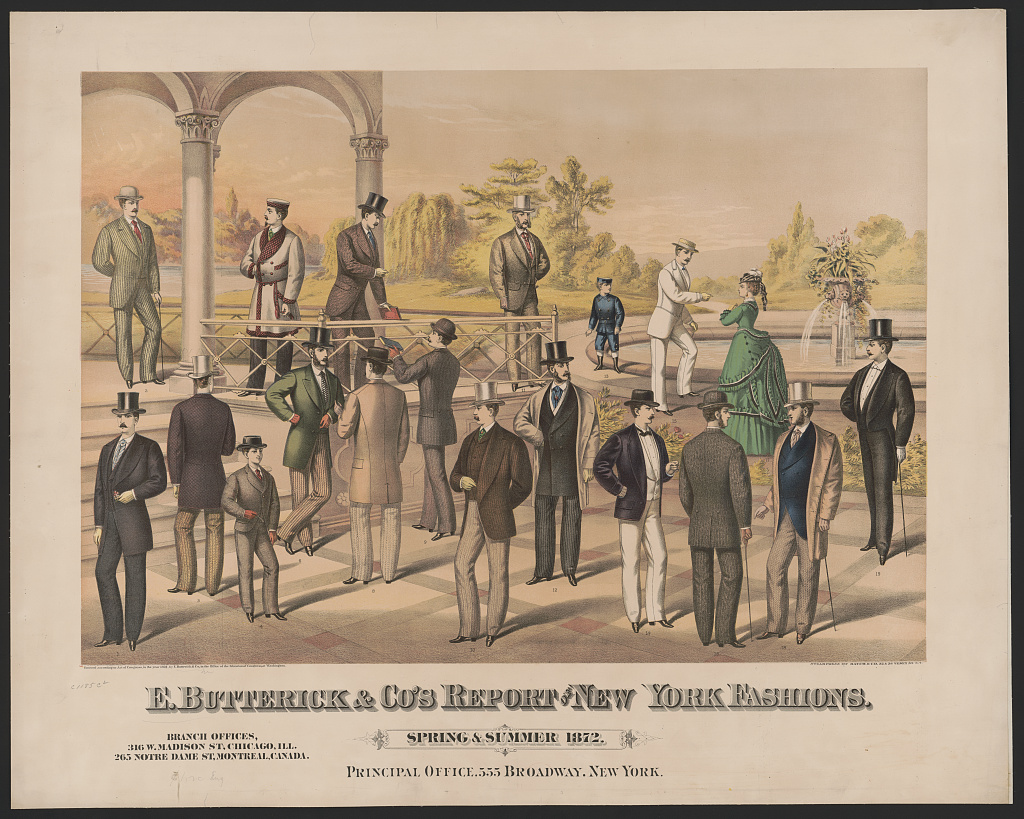
Look closely
Report of New York fashions, spring and summer 1872
Butterick & Co. · 1872 · Advertisement lithograph
The Butterick fashion sheet is both commerce and styling: garments, color, posture, grouping, typography, and season are composed into a public proposition while printmaker and company remain distinct records.
Object record and image details
- Collection number
- ppmsca.44953
- Credit
- Library of Congress Prints and Photographs Division
- Image terms
- Free to Use and Reuse / Library of Congress curated set
View the museum record ↗ · Download exhibition image ↓ · View the museum file ↗

COUNTERPOINT
What this framework could get wrong
Treating styling as authorship can erase the designer, photographer, model, hair and makeup teams, assistants, cultural sources, and commissioner; treating it as logistics erases interpretation. The answer is a role-specific record, not a larger heroic claim.
FIELDWORK
Do the work now
Use this as a working session, not a score.
- Choose one published fashion image and inventory every visible and credited contributor.
- Write the cultural proposition in one sentence, then list the styling decisions that support it.
- Attach agreements or mark fee, credit, approval, license, archive, and correction terms unresolved.
- Ask a relevant cultural specialist to review any reference whose authority the team does not hold.
What the sources establish
FIT describes stylists as developing visual brand and design concepts that guide work toward a finished product.
FIT’s Women of Harper’s Bazaar exhibition framed fashion publishing as collaboration among an editor, fashion editor, and photographer rather than the product of a single role.
A styling choice can shape public meaning without automatically establishing copyright ownership, contractual approval, or sole authorship.
Source note
An interpretation drawn from the linked records.
Open source S53 · Open source S54 · Open source S82 · Open source S83
READ / WATCH / LOOK CLOSER
Continue the story
Styling for Creative Media
Fashion Institute of Technology · current; accessed 2026-09-04
Open source ↗Source and use notes
Reference S82
Official program description may be paraphrased and linked; page imagery and embedded student work are not treated as open licensed.
LINK_ONLY
The Women of Harper's Bazaar, 1936–1958
Fashion Institute of Technology · 2016 exhibition record
Open source ↗Source and use notes
Reference S83
Official exhibition record may be paraphrased and linked; credited photographs remain copyright-controlled.
LINK_ONLY
17 U.S.C. § 101 — Definitions
U.S. House Office of the Law Revision Counsel · current preliminary edition
Open source ↗Source and use notes
Reference S53
U.S. statutory text; quote narrowly and link.
QUOTE_LINK
17 U.S.C. § 201 — Ownership of copyright
U.S. House Office of the Law Revision Counsel · current preliminary edition
Open source ↗Source and use notes
Reference S54
U.S. statutory text; quote narrowly and link.
QUOTE_LINK
17 U.S.C. § 204 — Execution of transfers of copyright ownership
U.S. House Office of the Law Revision Counsel · current preliminary edition
Open source ↗Source and use notes
Reference S55
U.S. statutory text; quote narrowly and link.
QUOTE_LINK
Standard Application Help: Author
U.S. Copyright Office · current; accessed 2026-09-04
Open source ↗Source and use notes
Reference S84
Official federal guidance; quote narrowly and preserve its fact-specific work-made-for-hire limits.
QUOTE_LINK
Personal Digital Archiving
Library of Congress · current; resources include 2013 publication
Open source ↗Source and use notes
Reference S08
Link and quote narrowly; check each downloadable resource before redistribution.
LINK_ONLY
Universal Electronic Records Management Requirements, Version 3
U.S. National Archives and Records Administration · 2023-06
Open source ↗Source and use notes
Reference S39
Government resource; link/download for education and do not imply endorsement.
LINK_ONLY
THE OBJECTS
Look at the material record
Each object extends the question through a different silhouette, material, function, or moment.
FROM THE COLLECTIONReport of New York fashions, spring and summer 1872
Butterick & Co. · 1872 · Advertisement lithograph
The sheet demonstrates a contract-shaped network of design, printing, manufacture, advertising, attribution, and distribution—even when the operative agreements are absent from the image.
Object record and image details
- Collection number
- ppmsca.44953
- Credit
- Library of Congress Prints and Photographs Division
- Image terms
- Free to Use and Reuse / Library of Congress curated set
- Origin
- Official institution collection record; independently catalogued, not AI-generated.
- Source
- View the museum record ↗
Download exhibition image ↓ · View the museum file ↗ · Download full image notes ↗
FURTHER READING
Archives, records, tools and learning
Personal Digital Archiving
Library of Congress · current; resources include 2013 publication
Open resource ↗Source and use notes
Reference S08
Link and quote narrowly; check each downloadable resource before redistribution.
LINK_ONLY
Universal Electronic Records Management Requirements, Version 3
U.S. National Archives and Records Administration · 2023-06
Open resource ↗Source and use notes
Reference S39
Government resource; link/download for education and do not imply endorsement.
LINK_ONLY
17 U.S.C. § 101 — Definitions
U.S. House Office of the Law Revision Counsel · current preliminary edition
Open resource ↗Source and use notes
Reference S53
U.S. statutory text; quote narrowly and link.
QUOTE_LINK
17 U.S.C. § 201 — Ownership of copyright
U.S. House Office of the Law Revision Counsel · current preliminary edition
Open resource ↗Source and use notes
Reference S54
U.S. statutory text; quote narrowly and link.
QUOTE_LINK
17 U.S.C. § 204 — Execution of transfers of copyright ownership
U.S. House Office of the Law Revision Counsel · current preliminary edition
Open resource ↗Source and use notes
Reference S55
U.S. statutory text; quote narrowly and link.
QUOTE_LINK
Styling for Creative Media
Fashion Institute of Technology · current; accessed 2026-09-04
Open resource ↗Source and use notes
Reference S82
Official program description may be paraphrased and linked; page imagery and embedded student work are not treated as open licensed.
LINK_ONLY
The Women of Harper's Bazaar, 1936–1958
Fashion Institute of Technology · 2016 exhibition record
Open resource ↗Source and use notes
Reference S83
Official exhibition record may be paraphrased and linked; credited photographs remain copyright-controlled.
LINK_ONLY
Standard Application Help: Author
U.S. Copyright Office · current; accessed 2026-09-04
Open resource ↗Source and use notes
Reference S84
Official federal guidance; quote narrowly and preserve its fact-specific work-made-for-hire limits.
QUOTE_LINK
The Fashion and Textile Museum collection and programme
Fashion and Textile Museum · current; accessed 2026-09-07
Open resource ↗Source and use notes
Reference X41
Official museum site; linked for research, with item-level media held from reproduction.
LINK_ONLY
Historical Resources: Fashion Industry
Library of Congress · updated 2026
Open resource ↗Source and use notes
Reference X58
Official research guide; linked as discovery infrastructure, not as a media license.
LINK_ONLY
Contemporary fashion designers on Balenciaga
Victoria and Albert Museum · 2023; accessed 2026-09-07
Open resource ↗Source and use notes
Reference X59
Protected first-party article and media; link and paraphrase only.
LINK_ONLY
Fashion at the Library
Library of Congress · current; accessed 2026-09-07
Open resource ↗Source and use notes
Reference X60
Discovery channel; each article and asset retains its own rights record.
LINK_ONLY
Research notes for this chapter
Exhaustive within the 18-surface registry and recorded queries; not a claim to every item on the internet.
- Places searched
- 18
- Records considered
- 13
- Images available for use
- 1
- Further-reading links
- 12
Stopped after all 18 named surfaces were queried on 2026-09-07; qualifying records were retained, exact duplicate URLs and assets were removed, every reusable file was checked at work and file level, and remaining no-result surfaces were named. New records or changed rights statements reopen the report.
Download detailed research notes ↓ · Read how the collection was assembled
FOLLOW THE QUESTION
One inquiry, six forms
- Canonical essay: The Meaning Between the Garments
- Nine-minute annotated-image film
- Eight-frame selection-and-power carousel
- Four styling evidence verticals
- Styling Meaning Ledger
- Newsletter, classroom, and commissioning editions
By RN Collins.
Download the chapter ↓ · Download source notes ↓
Practical and professional boundaries
Recorded performance, bespoke RN photography, participant releases, and counsel or specialist review are separate human-led work. They are not represented here as completed recordings, permissions, or professional opinions.
FIND IT ELSEWHERE
Where this dossier lives
How to read the source notes
Material statements link to the records behind them. Interpretation is not presented as source fact. Legal sections identify their jurisdiction; state, foreign, contractual, beneficial-ownership, validity, priority, and disputed-fact questions require appropriate professional review. This exhibition is educational and does not provide legal, conservation, or business advice.