Control · Institutions of One × Fashion
Archive study · Possession ≠ complete ownership
Who Owns the Archive?
A fashion archive is not one asset. It is a governed constellation of physical objects, copyrights, marks, contracts, files, testimony, privacy interests, access permissions, and institutional obligations.
Read the story00
The proposition
“Who owns the archive?” sounds singular because the boxes share a room. Under U.S. copyright law, however, ownership of a material object is distinct from ownership of copyright embodied in it. A garment, sketch, photograph, interview recording, database export, and trademark file can therefore sit together while their control travels through different records.
The first institutional task is not to crown one owner. It is to make an item-and-rights map that distinguishes custody, title, copyright, license, confidentiality, access, conservation duty, digitization permission, and interpretive authority—then sends disputed or jurisdiction-specific conclusions to counsel.
01–04
The institutional sequence
01 · INVENTORY
What is actually here?
Assign a persistent identifier to each object, file, recording, agreement, credential, and related record. Preserve original order and provenance before reorganizing for convenience.
Sources behind this section
An original working method informed by the linked records.
02 · SEPARATE
Which interest attaches to which item?
Record physical title, copyright authorship and transfers, trademark or design records, contract limits, privacy, access, and conservation separately. One accession row may need several rights rows.
03 · GOVERN
Who may possess, use, reproduce, lend, digitize, describe, and dispose?
Turn vague control into verbs, responsible parties, territory, term, approval, exceptions, recovery, and a source document. Unknown is a valid status; guessed ownership is not.
Sources behind this section
An original working method informed by the linked records.
04 · STEWARD
What must remain usable after a transfer?
Require identifiers, checksums, condition notes, formats, contextual narration, rights evidence, audit history, and a correction route to travel with the archive.
Sources behind this section
An original working method informed by the linked records.
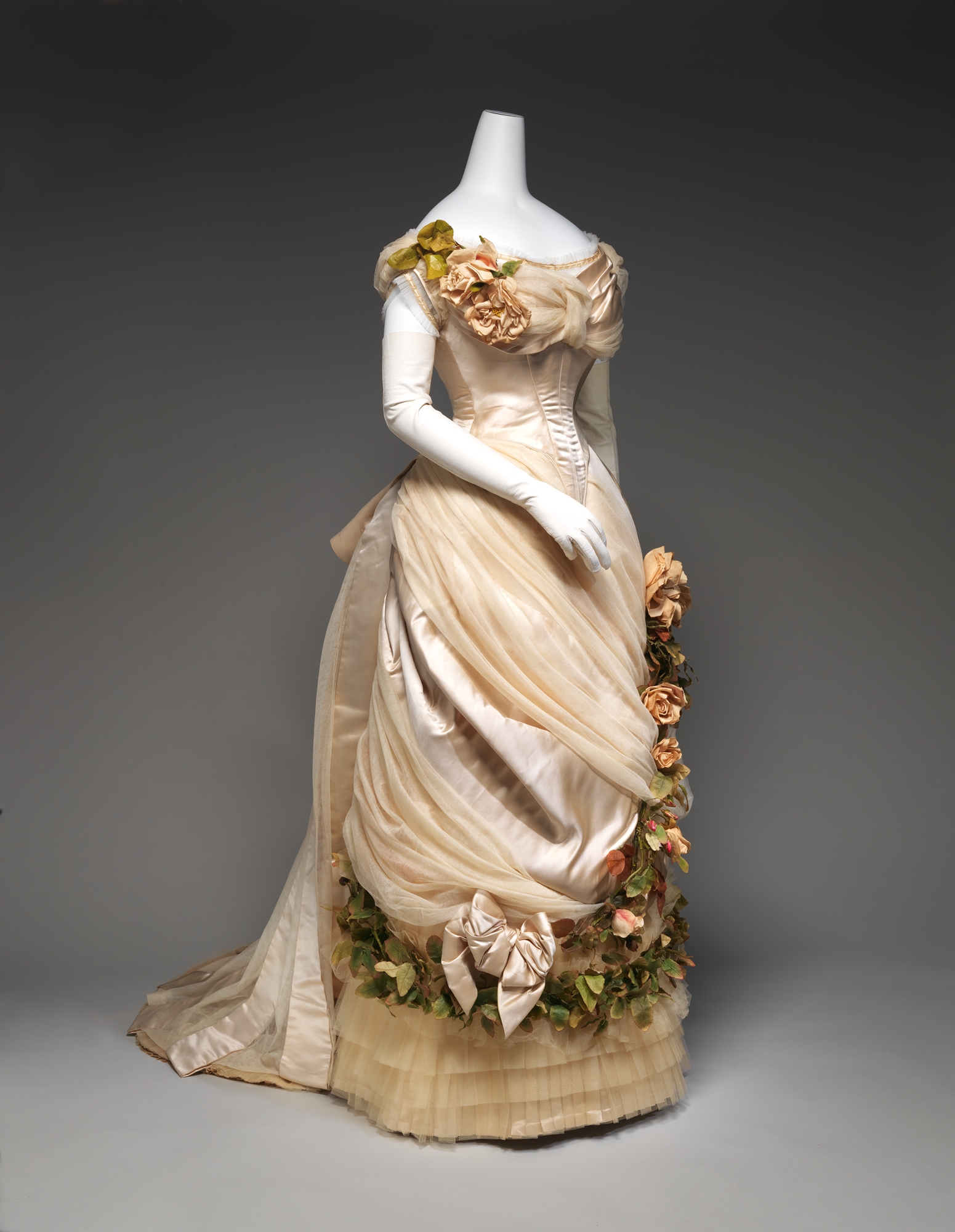
Look closely
Evening dress
House of Worth · ca. 1882 · Silk
The Met record keeps House of Worth attribution, Charles Frederick Worth design credit, physical medium, accession, credit line, and Public Domain image status distinct—an example of the layered record an archive needs.
Object record and image details
- Collection number
- 2009.300.635a, b
- Credit
- Brooklyn Museum Costume Collection at The Metropolitan Museum of Art, Gift of the Brooklyn Museum, 2009; Gift of the Princess Viggo in accordance with the wishes of the Misses Hewitt, 1931
- Image terms
- Public Domain / Met Open Access
View the museum record ↗ · Download exhibition image ↓ · View the museum file ↗

COUNTERPOINT
What this framework could get wrong
Fragmenting the archive into rights can obscure its cultural wholeness; treating it as culturally whole can obscure the rights and labor of photographers, makers, sitters, donors, employees, and communities. Ethical stewardship must keep both views in frame.
FIELDWORK
Do the work now
Use this as a working session, not a score.
- Select ten representative archive items and give each a stable identifier.
- For each, separate custody, material title, copyright, contract, privacy, access, and conservation evidence.
- Name the canonical record supporting each asserted power and mark every unknown.
- Send disputed title, copyright, contract, probate, privacy, and foreign-law questions to qualified counsel.
What the sources establish
Under U.S. law, ownership of a material object is distinct from ownership of copyright embodied in it.
An archive may contain garments, photographs, drawings, recordings, files, marks, contracts, and access credentials governed by different records and jurisdictions.
Source note
An interpretation drawn from the linked records.
Possession of the storage room or server does not by itself establish every underlying right.
READ / WATCH / LOOK CLOSER
Continue the story
17 U.S.C. § 201 — Ownership of copyright
U.S. Copyright Office · current
Open source ↗Source and use notes
Reference S63
Official statutory text; quote narrowly and link. Subsections (d) and (e) address transfer by law, will, or intestacy.
QUOTE_LINK
Personal Digital Archiving
Library of Congress · current; resources include 2013 publication
Open source ↗Source and use notes
Reference S08
Link and quote narrowly; check each downloadable resource before redistribution.
LINK_ONLY
Universal Electronic Records Management Requirements, Version 3
U.S. National Archives and Records Administration · 2023-06
Open source ↗Source and use notes
Reference S39
Government resource; link/download for education and do not imply endorsement.
LINK_ONLY
Appraisal Policy of the National Archives
U.S. National Archives and Records Administration · current policy; page updated 2026
Open source ↗Source and use notes
Reference S65
Official federal archival guidance; use as an authoritative method analogy, not as a rule governing private fashion archives.
LINK_ONLY
Standard Application Help: Claimant — transfer by inheritance
U.S. Copyright Office · current
Open source ↗Source and use notes
Reference S64
Official registration guidance; paraphrase and link. It does not resolve state probate or contract questions.
LINK_ONLY
Electronic Records Information for Archivists
U.S. National Archives and Records Administration · current
Open source ↗Source and use notes
Reference S66
Official preservation guidance; paraphrase and link. Federal requirements are not represented as binding on private archives.
LINK_ONLY
THE OBJECTS
Look at the material record
Each object extends the question through a different silhouette, material, function, or moment.
FROM THE COLLECTIONEvening dress
House of Worth · ca. 1882 · Silk
The record separates the material dress, House of Worth attribution, Charles Frederick Worth design credit, accession, and the museum’s present custody.
Object record and image details
- Collection number
- 2009.300.635a, b
- Credit
- Brooklyn Museum Costume Collection at The Metropolitan Museum of Art, Gift of the Brooklyn Museum, 2009; Gift of the Princess Viggo in accordance with the wishes of the Misses Hewitt, 1931
- Image terms
- Public Domain / Met Open Access
- Origin
- Official institution collection record; independently catalogued, not AI-generated.
- Source
- View the museum record ↗
Download exhibition image ↓ · View the museum file ↗ · Download full image notes ↗
FURTHER READING
Archives, records, tools and learning
Personal Digital Archiving
Library of Congress · current; resources include 2013 publication
Open resource ↗Source and use notes
Reference S08
Link and quote narrowly; check each downloadable resource before redistribution.
LINK_ONLY
Universal Electronic Records Management Requirements, Version 3
U.S. National Archives and Records Administration · 2023-06
Open resource ↗Source and use notes
Reference S39
Government resource; link/download for education and do not imply endorsement.
LINK_ONLY
17 U.S.C. § 201 — Ownership of copyright
U.S. Copyright Office · current
Open resource ↗Source and use notes
Reference S63
Official statutory text; quote narrowly and link. Subsections (d) and (e) address transfer by law, will, or intestacy.
QUOTE_LINK
Standard Application Help: Claimant — transfer by inheritance
U.S. Copyright Office · current
Open resource ↗Source and use notes
Reference S64
Official registration guidance; paraphrase and link. It does not resolve state probate or contract questions.
LINK_ONLY
Appraisal Policy of the National Archives
U.S. National Archives and Records Administration · current policy; page updated 2026
Open resource ↗Source and use notes
Reference S65
Official federal archival guidance; use as an authoritative method analogy, not as a rule governing private fashion archives.
LINK_ONLY
Electronic Records Information for Archivists
U.S. National Archives and Records Administration · current
Open resource ↗Source and use notes
Reference S66
Official preservation guidance; paraphrase and link. Federal requirements are not represented as binding on private archives.
LINK_ONLY
Smithsonian Open Access
Smithsonian Institution · current; accessed 2026-09-07
Open resource ↗Source and use notes
Reference X01
Portal identifies item-level CC0 assets; exact item status controls.
LINK_ONLY
Open Access FAQ
Smithsonian Institution · current; accessed 2026-09-07
Open resource ↗Source and use notes
Reference X02
Official explanation of CC0, formats, credit practice and remaining third-party restrictions.
LINK_ONLY
Europeana Rights Statements
Europeana · current; accessed 2026-09-07
Open resource ↗Source and use notes
Reference X26
Official item-rights vocabulary; provider item statement controls.
LINK_ONLY
DPLA Rights Statements
DPLA · current; accessed 2026-09-07
Open resource ↗Source and use notes
Reference X27
Official aggregator guidance; contributing institution record controls.
LINK_ONLY
National Archives records management guidance
NARA · current; accessed 2026-09-07
Open resource ↗Source and use notes
Reference X37
Official guidance; adapt as method, not a bespoke legal conclusion.
LINK_ONLY
J.Crew Employment Agreement: confidential creative records provisions
U.S. Securities and Exchange Commission · 2018
Open resource ↗Source and use notes
Reference X52
Official filing text; one agreement is not universal industry practice.
QUOTE_LINK
V&A Archives
Victoria and Albert Museum · current; accessed 2026-09-07
Open resource ↗Source and use notes
Reference X61
Finding and access information only; archival items retain their individual rights.
LINK_ONLY
Research notes for this chapter
Exhaustive within the 18-surface registry and recorded queries; not a claim to every item on the internet.
- Places searched
- 18
- Records considered
- 14
- Images available for use
- 1
- Further-reading links
- 13
Stopped after all 18 named surfaces were queried on 2026-09-07; qualifying records were retained, exact duplicate URLs and assets were removed, every reusable file was checked at work and file level, and remaining no-result surfaces were named. New records or changed rights statements reopen the report.
Download detailed research notes ↓ · Read how the collection was assembled
FOLLOW THE QUESTION
One inquiry, six forms
- Canonical 3,500-word essay
- Twelve-minute object-and-rights film
- Ten-frame “one room, many rights” carousel
- Four archive-ownership verticals
- Archive Rights Constellation interactive
- Newsletter, registrar, founder, and counsel-prep editions
By RN Collins.
Download the chapter ↓ · Download source notes ↓
Practical and professional boundaries
Recorded performance, bespoke RN photography, participant releases, and counsel or specialist review are separate human-led work. They are not represented here as completed recordings, permissions, or professional opinions.
FIND IT ELSEWHERE
Where this dossier lives
How to read the source notes
Material statements link to the records behind them. Interpretation is not presented as source fact. Legal sections identify their jurisdiction; state, foreign, contractual, beneficial-ownership, validity, priority, and disputed-fact questions require appropriate professional review. This exhibition is educational and does not provide legal, conservation, or business advice.