Carry · Institutions of One × Fashion
Transmission study · Archive → collaborator
Archive as Design Employee
An archive becomes institutional infrastructure when it is retrievable, interpretable, rights-aware, and capable of changing a live creative decision.
Read the story00
The proposition
A room full of garments is not automatically an archive, and an archive is not automatically useful. The institution begins when objects and records can answer a new question without severing evidence from interpretation.
Tapestry’s public filing states that designers use product-design archives as a resource for concepts. The Gianfranco Ferré Research Center presents another model: an archive organized for research and transmission. Neither source proves that every archive produces good design. They establish a narrower point—the archive can be deliberately operated as creative infrastructure.
01–04
The institutional sequence
01 · RETRIEVE
Can the right record be found?
Identifiers, dates, makers, materials, controlled vocabulary, file relationships, and search pathways determine whether memory is available at the moment of decision.
Sources behind this section
Directly supported by the linked records.
02 · READ
Can someone understand why it matters?
A sketch, fitting note, failed sample, or garment becomes more useful when the record preserves the question it answered—not only what it looks like.
Sources behind this section
An interpretation drawn from the linked records.
03 · TRANSFORM
Can the archive generate difference?
The strongest use is not literal revival. It is recovery of a method, constraint, construction problem, or unresolved question that can be recomposed for a new context.
Sources behind this section
An original working method informed by the linked records.
04 · CITE
Can the new work show its lineage?
Source identifiers, rights decisions, credits, and transformation notes let inspiration remain accountable. Citation does not weaken originality; it distinguishes research from extraction.
Sources behind this section
An original working method informed by the linked records.
Look closely
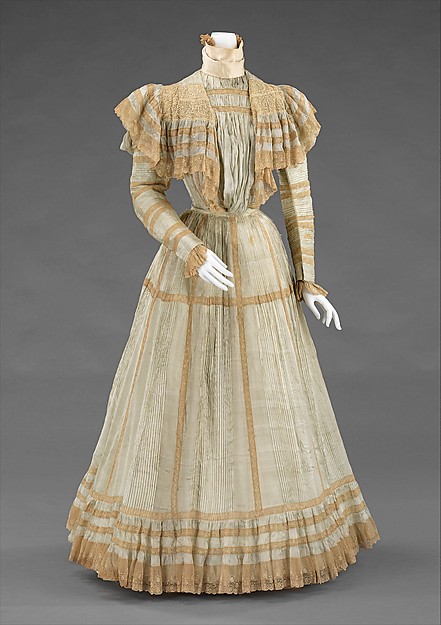
Afternoon dress
Jeanne Hallée · ca. 1900 · Silk
Jeanne Hallée’s afternoon dress makes a quieter institutional point: a house can remain researchable after public memory fades when maker, date, materials, accession, credit, and image rights survive together.
Object record and image details
- Collection number
- 2009.300.3098a, b
- Credit
- Brooklyn Museum Costume Collection at The Metropolitan Museum of Art; Gift of Marion Litchfield, 1950
- Image terms
- Public Domain / Met Open Access
View the museum record ↗ · Download exhibition image ↓ · View the museum file ↗
COUNTERPOINT
What this framework could get wrong
An archive can consolidate authority as easily as it distributes knowledge. Who receives access, who describes the objects, and whose labor appears in the metadata determines what the institution can remember.
FIELDWORK
Do the work now
Use this as a working session, not a score.
- Select one current design question—not a favorite old object.
- Retrieve three records that answer it in different ways.
- Record the evidentiary fact and your interpretation in separate fields.
- Define what may be reused, what may only be linked, and what requires permission.
What the sources establish
Tapestry reports that designers use product-design archives as a resource for concepts.
An archive can function as active design infrastructure.
Source note
An interpretation drawn from the linked records.
READ / WATCH / LOOK CLOSER
Continue the story
Tapestry, Inc. Form 10-K for year ended June 27, 2026
U.S. Securities and Exchange Commission · 2026
Open source ↗Source and use notes
Reference S35
Public filing; quote narrowly and transform facts into original diagrams.
QUOTE_LINK
Gianfranco Ferré Research Center
Politecnico di Milano / Google Arts & Culture · center established 2021
Open source ↗Source and use notes
Reference S21
Use an official embed only if offered; otherwise link only.
LINK_ONLY
Gianfranco Ferré Research Center
Politecnico di Milano / Google Arts & Culture · current story
Open source ↗Source and use notes
Reference S22
Use an official embed only if offered; otherwise link only.
LINK_ONLY
Condé Nast Archive
Condé Nast / Google Arts & Culture · archive since 1909
Open source ↗Source and use notes
Reference S23
Copyright controlled by Condé Nast and creators; licensing required for media.
LINK_ONLY
HCC Fashion Archive
Houston City College / Google Arts & Culture · collection spans 1740s–2000s
Open source ↗Source and use notes
Reference S24
Free research access is not an open media license.
LINK_ONLY
THE OBJECTS
Look at the material record
Each object extends the question through a different silhouette, material, function, or moment.
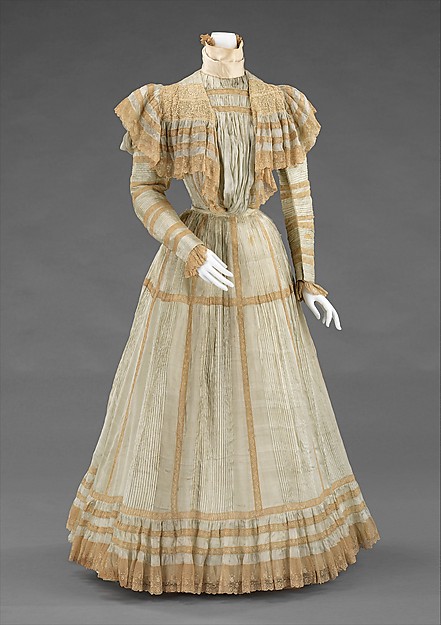
FROM THE COLLECTIONAfternoon dress
Jeanne Hallée · ca. 1900 · Silk
A less-remembered house remains researchable because its object record survives.
Object record and image details
- Collection number
- 2009.300.3098a, b
- Credit
- Brooklyn Museum Costume Collection at The Metropolitan Museum of Art; Gift of Marion Litchfield, 1950
- Image terms
- Public Domain / Met Open Access
- Origin
- Official institution collection record; independently catalogued, not AI-generated.
- Source
- View the museum record ↗
Download exhibition image ↓ · View the museum file ↗ · Download full image notes ↗
FURTHER READING
Archives, records, tools and learning
Gianfranco Ferré Research Center
Politecnico di Milano / Google Arts & Culture · center established 2021
Open resource ↗Source and use notes
Reference S21
Use an official embed only if offered; otherwise link only.
LINK_ONLY
Gianfranco Ferré Research Center
Politecnico di Milano / Google Arts & Culture · current story
Open resource ↗Source and use notes
Reference S22
Use an official embed only if offered; otherwise link only.
LINK_ONLY
Condé Nast Archive
Condé Nast / Google Arts & Culture · archive since 1909
Open resource ↗Source and use notes
Reference S23
Copyright controlled by Condé Nast and creators; licensing required for media.
LINK_ONLY
HCC Fashion Archive
Houston City College / Google Arts & Culture · collection spans 1740s–2000s
Open resource ↗Source and use notes
Reference S24
Free research access is not an open media license.
LINK_ONLY
Tapestry, Inc. Form 10-K for year ended June 27, 2026
U.S. Securities and Exchange Commission · 2026
Open resource ↗Source and use notes
Reference S35
Public filing; quote narrowly and transform facts into original diagrams.
QUOTE_LINK
Smithsonian Open Access
Smithsonian Institution · current; accessed 2026-09-07
Open resource ↗Source and use notes
Reference X01
Portal identifies item-level CC0 assets; exact item status controls.
LINK_ONLY
The World of Anna Sui
Museum of Arts and Design · 2019
Open resource ↗Source and use notes
Reference X07
Official exhibition record; page imagery is not treated as open licensed.
LINK_ONLY
Special Collections and FIT Archive
Fashion Institute of Technology · current; accessed 2026-09-07
Open resource ↗Source and use notes
Reference X10
Discovery portal; item-level conditions govern all media.
LINK_ONLY
Fashion collection
Victoria and Albert Museum · collection current; accessed 2026-09-07
Open resource ↗Source and use notes
Reference X11
Link and cite; exact object/media rights govern reproduction.
LINK_ONLY
Dive into Color / collection-data experiments
Cooper Hewitt, Smithsonian Design Museum · 2018
Open resource ↗Source and use notes
Reference X12
Link to the documented interactive experiment; code or imagery is not copied without an exact license.
LINK_ONLY
Open Access API
The Metropolitan Museum of Art · current; accessed 2026-09-07
Open resource ↗Source and use notes
Reference X23
API documentation; object-level Public Domain status controls media reuse.
LINK_ONLY
Smithsonian Open Access developer tools
Smithsonian Institution · current; accessed 2026-09-07
Open resource ↗Source and use notes
Reference X24
Official API documentation; item-level restrictions still control.
LINK_ONLY
Cooper Hewitt Collection API
Cooper Hewitt · current; accessed 2026-09-07
Open resource ↗Source and use notes
Reference X25
Link to official API; individual collection objects retain their stated rights.
LINK_ONLY
V&A Archives
Victoria and Albert Museum · current; accessed 2026-09-07
Open resource ↗Source and use notes
Reference X61
Finding and access information only; archival items retain their individual rights.
LINK_ONLY
Sustainability of Digital Formats
Library of Congress · current; accessed 2026-09-07
Open resource ↗Source and use notes
Reference X63
Official technical guidance; link and quote narrowly.
LINK_ONLY
Research notes for this chapter
Exhaustive within the 18-surface registry and recorded queries; not a claim to every item on the internet.
- Places searched
- 18
- Records considered
- 16
- Images available for use
- 1
- Further-reading links
- 15
Stopped after all 18 named surfaces were queried on 2026-09-07; qualifying records were retained, exact duplicate URLs and assets were removed, every reusable file was checked at work and file level, and remaining no-result surfaces were named. New records or changed rights statements reopen the report.
Download detailed research notes ↓ · Read how the collection was assembled
FOLLOW THE QUESTION
One inquiry, six forms
- Canonical archive-as-employee essay
- Four-movement scroll narrative
- Six-part archive literacy short series
- Archive Activation interactive
- Metadata and rights worksheet
- Downloadable package brief and evidence register
By RN Collins.
Download the chapter ↓ · Download source notes ↓
Practical and professional boundaries
Recorded performance, bespoke RN photography, participant releases, and counsel or specialist review are separate human-led work. They are not represented here as completed recordings, permissions, or professional opinions.
FIND IT ELSEWHERE
Where this dossier lives
How to read the source notes
Material statements link to the records behind them. Interpretation is not presented as source fact. Legal sections identify their jurisdiction; state, foreign, contractual, beneficial-ownership, validity, priority, and disputed-fact questions require appropriate professional review. This exhibition is educational and does not provide legal, conservation, or business advice.