Carry · Institutions of One × Fashion
Carry study · Drawing → pattern → body
The Patternmaker Behind the Designer
The patternmaker is not a neutral copying machine: pattern work carries design intention into geometry, fit, construction, repeatability, and the body through skilled decisions that deserve explicit evidence, authority, and credit.
Read the story00
The proposition
Fashion mythology often lets a sketch travel directly to a finished garment. Patternmaking occupies the consequential middle. FIT’s current program description names draping, marker making, patternmaking, sample making, knowledge, craftsmanship, and techniques. Its archived 1995 oral history preserves three patternmaking professors discussing slopers, specialized instruction, technology, union history, and long ties to textile work. These sources establish patternmaking as a skilled field; they do not tell us who controlled any private workroom or who legally authored a particular garment.
The V&A’s accounts of Cristóbal Balenciaga and Alexander McQueen make a second, carefully bounded point: pattern cutting was part of those designers’ own training and practice. That history complicates any fixed opposition between “designer” and “patternmaker.” In one house the founder may cut; in another, a specialist may translate, challenge, or co-develop the form. The correct institutional question is not who usually does it, but which person made which decision, from what brief, with what authority, and where that knowledge now lives.
01–04
The institutional sequence
01 · BRIEF
What is the design asking the pattern to do?
Record silhouette, balance, ease, movement, material behavior, size range, construction, finish, cost, time, accessibility, and the non-negotiable visual idea. A sketch alone rarely carries all of this.
Sources behind this section
An original working method informed by the linked records.
02 · JUDGMENT
Which decisions belong to the patternmaker?
Log the alteration, reason, evidence, person deciding, person approving, affected sizes and materials, and whether the change is technical, aesthetic, safety-related, or commercial. Skilled translation should remain attributable.
Sources behind this section
An interpretation drawn from the linked records.
03 · FIT
Whose body becomes the standard?
Identify the block, fit model or measurement source, sample size, grading method, movement test, wearer feedback, and excluded bodies. A technically repeatable pattern can still institutionalize a narrow body assumption.
Sources behind this section
An original working method informed by the linked records.
04 · RETAIN
Can the knowledge survive the specialist’s absence?
Preserve pattern version, annotation, toile images where permitted, fitting decisions, known failures, material constraints, maker credit, access rules, and a route for future questions. The file is evidence; narration explains the judgment.
Sources behind this section
An original working method informed by the linked records.
Look closely
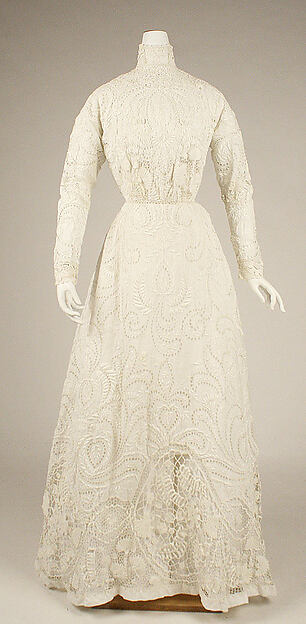
Dress
American or European · ca. 1903 · Linen, cotton
The Met preserves this dress’s material, date, accession, and physical form while identifying the maker only as American or European. Its surviving construction makes the absent production knowledge palpable without pretending the museum record can name the patternmaker.
Object record and image details
- Collection number
- 1976.258.13
- Credit
- Gift of Miss Eva Drexel Dahlgren, 1976
- Image terms
- Public Domain / Met Open Access
View the museum record ↗ · Download exhibition image ↓ · View the museum file ↗
COUNTERPOINT
What this framework could get wrong
Calling patternmaking authorship can illuminate judgment but also blur distinct legal categories or erase sewing, fitting, grading, textile, and production labor. The answer is not to replace one hero with another. It is to make the chain of contribution and decision precise.
FIELDWORK
Do the work now
Use this as a working session, not a score.
- Select one garment and pair the approved sketch, first pattern, first toile, fitting record, production pattern, and final object.
- Interview the patternmaker about three changes that are invisible in the finished photograph.
- Record who proposed, tested, approved, rejected, and documented each change.
- Audit fit assumptions, size coverage, credit, compensation, file custody, reuse, and succession with the actual participants.
What the sources establish
FIT describes patternmaking education as including draping, marker making, patternmaking, sample making, knowledge, craftsmanship, and technique.
The V&A records pattern cutting as material to the formation and practice of designers including Cristóbal Balenciaga and Alexander McQueen.
A patternmaker translates design intention through skilled judgment; the precise authority, authorship, employment status, and credit must be established from the actual relationship and records.
Source note
An interpretation drawn from the linked records.
Open source S72 · Open source S73 · Open source S74 · Open source S75
READ / WATCH / LOOK CLOSER
Continue the story
Patternmaking certificate
Fashion Institute of Technology · current
Open source ↗Source and use notes
Reference S73
Official curriculum description; paraphrase and link. Page media is not treated as open licensed.
LINK_ONLY
Introducing Cristóbal Balenciaga
Victoria and Albert Museum · updated 2024-04-17
Open source ↗Source and use notes
Reference S74
Museum interpretation may be cited and paraphrased; imagery remains link-only absent item-level permission.
LINK_ONLY
Alexander McQueen — an introduction
Victoria and Albert Museum · updated 2024-04-17
Open source ↗Source and use notes
Reference S75
Museum interpretation may be cited and paraphrased; imagery remains link-only absent item-level permission.
LINK_ONLY
Interview of Christine Pupillo, Leonard Trattner, and Harry Greenberg of the Patternmaking Department
Fashion Institute of Technology Special Collections and College Archives · 1995-02-27; digitized 2020
Open source ↗Source and use notes
Reference S72
In Copyright; FIT prohibits copying, display, or upload without permission except reviewed fair use. Link to the item and do not embed its media.
LINK_ONLY
Personal Digital Archiving
Library of Congress · current; resources include 2013 publication
Open source ↗Source and use notes
Reference S08
Link and quote narrowly; check each downloadable resource before redistribution.
LINK_ONLY
Universal Electronic Records Management Requirements, Version 3
U.S. National Archives and Records Administration · 2023-06
Open source ↗Source and use notes
Reference S39
Government resource; link/download for education and do not imply endorsement.
LINK_ONLY
THE OBJECTS
Look at the material record
Each object extends the question through a different silhouette, material, function, or moment.
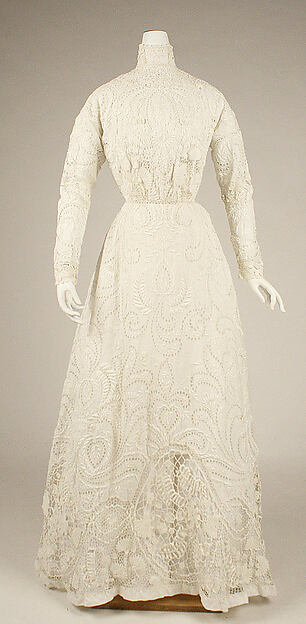
FROM THE COLLECTIONDress
American or European · ca. 1903 · Linen, cotton
Construction evidence can outlive the operating house—but only if the physical object and record stay paired.
Object record and image details
- Collection number
- 1976.258.13
- Credit
- Gift of Miss Eva Drexel Dahlgren, 1976
- Image terms
- Public Domain / Met Open Access
- Origin
- Official institution collection record; independently catalogued, not AI-generated.
- Source
- View the museum record ↗
Download exhibition image ↓ · View the museum file ↗ · Download full image notes ↗
 FROM THE COLLECTION
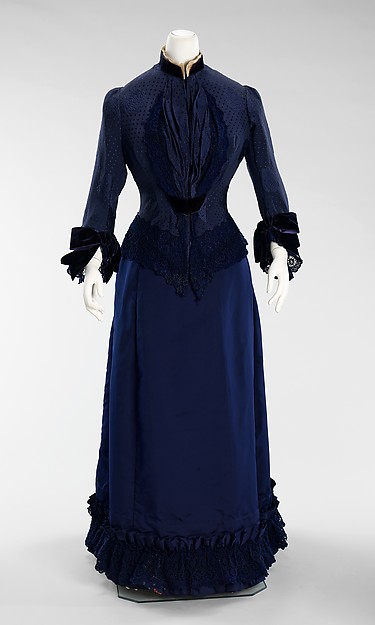
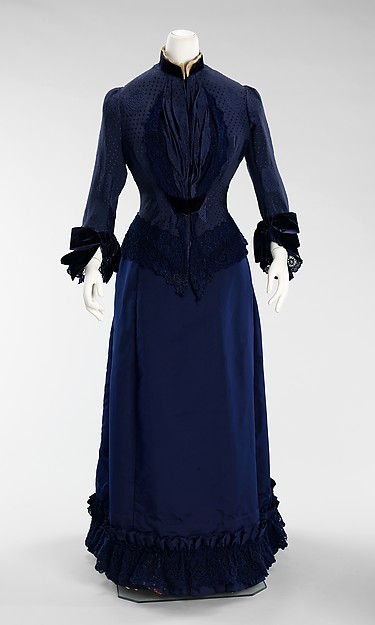
Dress
Maison Pingat · ca. 1885 · Silk, cotton
Maison Pingat survives here through an exact maker record, construction evidence, custody, and an open image—not through fame alone.
Object record and image details
- Collection number
- 2009.300.628a, b
- Credit
- Brooklyn Museum Costume Collection at The Metropolitan Museum of Art; Gift of Lillian E. Glenn Peirce and Mabel Glenn Cooper, 1929
- Image terms
- Public Domain / Met Open Access
- Origin
- Official institution collection record; independently catalogued, not AI-generated.
- Source
- View the museum record ↗
Download exhibition image ↓ · View the museum file ↗ · Download full image notes ↗
FURTHER READING
Archives, records, tools and learning
Personal Digital Archiving
Library of Congress · current; resources include 2013 publication
Open resource ↗Source and use notes
Reference S08
Link and quote narrowly; check each downloadable resource before redistribution.
LINK_ONLY
Universal Electronic Records Management Requirements, Version 3
U.S. National Archives and Records Administration · 2023-06
Open resource ↗Source and use notes
Reference S39
Government resource; link/download for education and do not imply endorsement.
LINK_ONLY
Interview of Christine Pupillo, Leonard Trattner, and Harry Greenberg of the Patternmaking Department
Fashion Institute of Technology Special Collections and College Archives · 1995-02-27; digitized 2020
Open resource ↗Source and use notes
Reference S72
In Copyright; FIT prohibits copying, display, or upload without permission except reviewed fair use. Link to the item and do not embed its media.
LINK_ONLY
Patternmaking certificate
Fashion Institute of Technology · current
Open resource ↗Source and use notes
Reference S73
Official curriculum description; paraphrase and link. Page media is not treated as open licensed.
LINK_ONLY
Introducing Cristóbal Balenciaga
Victoria and Albert Museum · updated 2024-04-17
Open resource ↗Source and use notes
Reference S74
Museum interpretation may be cited and paraphrased; imagery remains link-only absent item-level permission.
LINK_ONLY
Alexander McQueen — an introduction
Victoria and Albert Museum · updated 2024-04-17
Open resource ↗Source and use notes
Reference S75
Museum interpretation may be cited and paraphrased; imagery remains link-only absent item-level permission.
LINK_ONLY
Special Collections and FIT Archive
Fashion Institute of Technology · current; accessed 2026-09-07
Open resource ↗Source and use notes
Reference X10
Discovery portal; item-level conditions govern all media.
LINK_ONLY
Dress
The Metropolitan Museum of Art · ca. 1885; accessed 2026-09-07
Open resource ↗Source and use notes
Reference X14
Public Domain under Met Open Access; exact image installed separately.
PUBLIC_DOMAIN_CC0
Shelter and clothing
Library of Congress · 1913
Open resource ↗Source and use notes
Reference X16
Library of Congress item identifies the work as free to use and reuse.
LINK_ONLY
A system for cutting ladies garments
Library of Congress · 1917
Open resource ↗Source and use notes
Reference X17
Library of Congress item identifies the work as free to use and reuse.
LINK_ONLY
Dressmaking
Internet Archive · 1917
Open resource ↗Source and use notes
Reference X43
Work-level public-domain-era candidate; Internet Archive availability alone is not file-level permission, so linked pending scan-source verification.
LINK_ONLY
Pattern making
Internet Archive · 1922
Open resource ↗Source and use notes
Reference X44
Work-level public-domain-era candidate; file provenance requires item review before local ingest.
LINK_ONLY
Complete course in dressmaking: Draping and Pattern Making
Internet Archive · 1922
Open resource ↗Source and use notes
Reference X45
Linked at work level; the exact derivative file and scan-source rights were not independently cleared for redistribution.
LINK_ONLY
Drafting trousers for men, boys, women
Internet Archive · 1945
Open resource ↗Source and use notes
Reference X46
Item page displays Public Domain Mark 1.0; retained as a canonical resource rather than duplicating its derivative files.
LINK_ONLY
Learning from “The Master”
Victoria and Albert Museum · 2023; accessed 2026-09-07
Open resource ↗Source and use notes
Reference X49
Protected first-party media; link or authorized player only.
AUTHORIZED_EMBED
Research notes for this chapter
Exhaustive within the 18-surface registry and recorded queries; not a claim to every item on the internet.
- Places searched
- 18
- Records considered
- 17
- Images available for use
- 3
- Further-reading links
- 14
Stopped after all 18 named surfaces were queried on 2026-09-07; qualifying records were retained, exact duplicate URLs and assets were removed, every reusable file was checked at work and file level, and remaining no-result surfaces were named. New records or changed rights statements reopen the report.
Download detailed research notes ↓ · Read how the collection was assembled
FOLLOW THE QUESTION
One inquiry, six forms
- Canonical patternmaker essay
- Twelve-minute sketch-to-body film
- Ten-frame “the missing middle” carousel
- Five pattern-judgment shorts
- Pattern Decision Ledger
- Newsletter, fitting-room, classroom, and archive editions
By RN Collins.
Download the chapter ↓ · Download source notes ↓
Practical and professional boundaries
Recorded performance, bespoke RN photography, participant releases, and counsel or specialist review are separate human-led work. They are not represented here as completed recordings, permissions, or professional opinions.
FIND IT ELSEWHERE
Where this dossier lives
How to read the source notes
Material statements link to the records behind them. Interpretation is not presented as source fact. Legal sections identify their jurisdiction; state, foreign, contractual, beneficial-ownership, validity, priority, and disputed-fact questions require appropriate professional review. This exhibition is educational and does not provide legal, conservation, or business advice.