Carry · Institutions of One × Fashion
Carry study · Vision → production system
Who Carries a Creative Vision Into Production?
Creative vision reaches production through negotiated translations among people, factories, contractors, files, budgets, standards, law, and material limits; the process distributes power rather than merely executing a designer’s command.
Read the story00
The proposition
“Take it into production” hides more than it explains. Depending on the organization, work may move through an internal atelier, pattern and technical teams, sample rooms, suppliers, agents, factories, licensees, logistics partners, independent contractors, or several jurisdictions. None of those arrangements should be inferred from a brand’s scale or a garment’s finish. The map must be built from actual records and participant testimony.
The Department of Labor’s garment resources make labor and compliance visible as part of production rather than as an afterthought. A public Mossimo–Target agreement offers a separate documentary window into one negotiated system involving design materials, design services, approvals, manufacturing-related obligations, distribution, channels, publicity, and marks. It does not establish an industry norm. It shows why production is institutional: a creative instruction becomes operational only after authority, specifications, labor, money, risk, and remedies are allocated.
01–04
The institutional sequence
01 · TRANSLATE
What does “the vision” mean operationally?
Turn aesthetic direction into testable specifications while preserving the reason behind them: material, construction, tolerance, finish, movement, color, hand, durability, repair, packaging, cost, timing, and acceptable variation.
Sources behind this section
An original working method informed by the linked records.
02 · LOCATE LABOR
Who performs each transformation?
Name the actual employer, worker, contractor, vendor, or licensee where verified; record jurisdiction, role, classification source, wage-and-hour review, safety route, language access, and subcontracting uncertainty. Do not let a purchase order erase people.
Sources behind this section
An original working method informed by the linked records.
03 · ALLOCATE POWER
Who can approve, reject, revise, pause, and be paid?
Bind decisions to thresholds, response times, evidence, escalation, payment milestones, change-order treatment, quality disputes, intellectual-property terms, confidentiality, and termination. “Final approval” must name both subject and consequence.
04 · CLOSE THE LOOP
What returns from production to the house?
Capture deviations, defects, worker or supplier feedback, material substitutions, fit outcomes, quantities, waste, cost changes, approvals, corrected specifications, provenance, and archive records so production knowledge can alter the next collection.
Sources behind this section
An original working method informed by the linked records.
Look closely
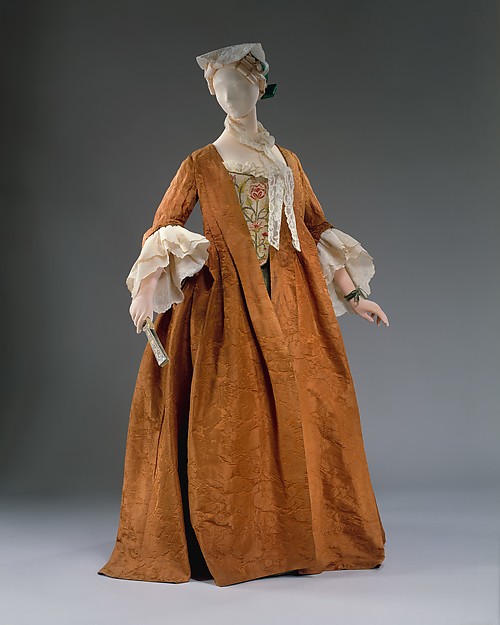
Dress
French · 1735–40 · Silk, flax
The Met record preserves materials and finished form but cannot reconstruct the many hands, instructions, economic terms, or workroom decisions that produced this eighteenth-century dress. The absence is the evidentiary prompt: beauty is not a complete production record.
Object record and image details
- Collection number
- 1983.399.1
- Credit
- Gift of Mary Tavener Holmes, 1983
- Image terms
- Public Domain / Met Open Access
View the museum record ↗ · Download exhibition image ↓ · View the museum file ↗

COUNTERPOINT
What this framework could get wrong
A highly documented production system can improve accountability yet push surveillance and paperwork onto workers with the least power. A house can also use technical standards to demand impossible precision without paying for development or change. Documentation must support remedy, learning, and fair allocation—not merely brand protection.
FIELDWORK
Do the work now
Use this as a working session, not a score.
- Trace one style from approved concept through every entity, location, file, sample, shipment, and approval to final receipt.
- Identify every place where subcontracting, classification, pay, safety, or decision authority is unknown.
- Compare the written specification with the production outcome and record each deviation and who absorbed its cost.
- Interview participants separately about where the process lost information or shifted risk, then preserve disagreement rather than averaging it away.
What the sources establish
U.S. Department of Labor garment-industry resources address federal wage, hour, recordkeeping, contractor, and compliance questions relevant to covered workplaces.
The public Mossimo–Target agreement demonstrates one negotiated division among design, materials, approvals, manufacture, distribution, channels, and publicity.
Production handoffs distribute creative, technical, commercial, and labor power, but the distribution is not identical across houses, jurisdictions, or worker classifications.
Source note
An interpretation drawn from the linked records.
READ / WATCH / LOOK CLOSER
Continue the story
Garment Industry Compliance Assistance Toolkit
U.S. Department of Labor, Wage and Hour Division · updated 2025-09-23
Open source ↗Source and use notes
Reference S76
Official federal labor resource; paraphrase and link. Do not imply endorsement or that one federal toolkit resolves every employment arrangement.
LINK_ONLY
Garment industry resources
U.S. Department of Labor, Wage and Hour Division · current
Open source ↗Source and use notes
Reference S81
Official federal labor information; paraphrase and link. Jurisdiction, worker classification, and facts require case-specific review.
LINK_ONLY
Restated License Agreement between Target Brands, Inc., Mossimo, Inc., and Mossimo Giannulli
U.S. Securities and Exchange Commission · public exhibit filed 2006
Open source ↗Source and use notes
Reference S77
Public SEC filing; quote narrowly, link to the exhibit, and distinguish this negotiated arrangement from general industry practice.
QUOTE_LINK
Patternmaking certificate
Fashion Institute of Technology · current
Open source ↗Source and use notes
Reference S73
Official curriculum description; paraphrase and link. Page media is not treated as open licensed.
LINK_ONLY
Regulation (EU) 2024/1781 establishing a framework for ecodesign requirements for sustainable products
European Parliament and Council / EUR-Lex · 2024-06-13; OJ 2024-06-28
Open source ↗Source and use notes
Reference S38
Link and quote relevant provisions under EUR-Lex reuse policy.
QUOTE_LINK
THE OBJECTS
Look at the material record
Each object extends the question through a different silhouette, material, function, or moment.
FROM THE COLLECTIONDress
French · 1735–40 · Silk, flax
A garment record becomes institutional evidence when material, date, maker, identifier, and rights remain attached.
Object record and image details
- Collection number
- 1983.399.1
- Credit
- Gift of Mary Tavener Holmes, 1983
- Image terms
- Public Domain / Met Open Access
- Origin
- Official institution collection record; independently catalogued, not AI-generated.
- Source
- View the museum record ↗
Download exhibition image ↓ · View the museum file ↗ · Download full image notes ↗
FURTHER READING
Archives, records, tools and learning
Regulation (EU) 2024/1781 establishing a framework for ecodesign requirements for sustainable products
European Parliament and Council / EUR-Lex · 2024-06-13; OJ 2024-06-28
Open resource ↗Source and use notes
Reference S38
Link and quote relevant provisions under EUR-Lex reuse policy.
QUOTE_LINK
Patternmaking certificate
Fashion Institute of Technology · current
Open resource ↗Source and use notes
Reference S73
Official curriculum description; paraphrase and link. Page media is not treated as open licensed.
LINK_ONLY
Garment Industry Compliance Assistance Toolkit
U.S. Department of Labor, Wage and Hour Division · updated 2025-09-23
Open resource ↗Source and use notes
Reference S76
Official federal labor resource; paraphrase and link. Do not imply endorsement or that one federal toolkit resolves every employment arrangement.
LINK_ONLY
Restated License Agreement between Target Brands, Inc., Mossimo, Inc., and Mossimo Giannulli
U.S. Securities and Exchange Commission · public exhibit filed 2006
Open resource ↗Source and use notes
Reference S77
Public SEC filing; quote narrowly, link to the exhibit, and distinguish this negotiated arrangement from general industry practice.
QUOTE_LINK
Garment industry resources
U.S. Department of Labor, Wage and Hour Division · current
Open resource ↗Source and use notes
Reference S81
Official federal labor information; paraphrase and link. Jurisdiction, worker classification, and facts require case-specific review.
LINK_ONLY
Vestments and how to make them
Library of Congress · 1914
Open resource ↗Source and use notes
Reference X15
Library of Congress item identifies the work as free to use and reuse.
LINK_ONLY
Shelter and clothing
Library of Congress · 1913
Open resource ↗Source and use notes
Reference X16
Library of Congress item identifies the work as free to use and reuse.
LINK_ONLY
Feedsack dress
National Museum of American History · twentieth century; accessed 2026-09-07
Open resource ↗Source and use notes
Reference X19
Smithsonian record marks the digital asset CC0; canonical record retained.
LINK_ONLY
Garment industry compliance resources
U.S. Department of Labor · current; accessed 2026-09-07
Open resource ↗Source and use notes
Reference X33
Official guidance; jurisdiction and worker facts remain case-specific.
LINK_ONLY
ILO Better Work programme
International Labour Organization · current; accessed 2026-09-07
Open resource ↗Source and use notes
Reference X34
Link and summarize with geography and methods intact.
LINK_ONLY
UNESCO Intangible Cultural Heritage Lists
UNESCO · current; accessed 2026-09-07
Open resource ↗Source and use notes
Reference X35
Official registry; inscription is not a media license or ownership ruling.
LINK_ONLY
Dressmaking
Internet Archive · 1917
Open resource ↗Source and use notes
Reference X43
Work-level public-domain-era candidate; Internet Archive availability alone is not file-level permission, so linked pending scan-source verification.
LINK_ONLY
Complete course in dressmaking: Draping and Pattern Making
Internet Archive · 1922
Open resource ↗Source and use notes
Reference X45
Linked at work level; the exact derivative file and scan-source rights were not independently cleared for redistribution.
LINK_ONLY
Drafting trousers for men, boys, women
Internet Archive · 1945
Open resource ↗Source and use notes
Reference X46
Item page displays Public Domain Mark 1.0; retained as a canonical resource rather than duplicating its derivative files.
LINK_ONLY
Sew your own: kimono-inspired dress
Victoria and Albert Museum · 2023; accessed 2026-09-07
Open resource ↗Source and use notes
Reference X50
First-party educational page; patterns and page media remain under their stated site conditions.
LINK_ONLY
Fashion at the Library
Library of Congress · current; accessed 2026-09-07
Open resource ↗Source and use notes
Reference X60
Discovery channel; each article and asset retains its own rights record.
LINK_ONLY
Research notes for this chapter
Exhaustive within the 18-surface registry and recorded queries; not a claim to every item on the internet.
- Places searched
- 18
- Records considered
- 17
- Images available for use
- 1
- Further-reading links
- 16
Stopped after all 18 named surfaces were queried on 2026-09-07; qualifying records were retained, exact duplicate URLs and assets were removed, every reusable file was checked at work and file level, and remaining no-result surfaces were named. New records or changed rights statements reopen the report.
Download detailed research notes ↓ · Read how the collection was assembled
FOLLOW THE QUESTION
One inquiry, six forms
- Canonical production-power essay
- Fifteen-minute vision-to-factory film
- Twelve-frame handoff-and-risk carousel
- Six production-system verticals
- Vision-to-Production Handoff Map
- Newsletter, supplier, studio, and worker-review editions
By RN Collins.
Download the chapter ↓ · Download source notes ↓
Practical and professional boundaries
Recorded performance, bespoke RN photography, participant releases, and counsel or specialist review are separate human-led work. They are not represented here as completed recordings, permissions, or professional opinions.
FIND IT ELSEWHERE
Where this dossier lives
How to read the source notes
Material statements link to the records behind them. Interpretation is not presented as source fact. Legal sections identify their jurisdiction; state, foreign, contractual, beneficial-ownership, validity, priority, and disputed-fact questions require appropriate professional review. This exhibition is educational and does not provide legal, conservation, or business advice.