Continue · Institutions of One × Fashion
Continue study · Voice → decision context
The Oral History Is a Succession Document
Oral history becomes succession infrastructure when it preserves decision context, contradiction, sensory judgment, relationships, boundaries, and the narrator’s authority over access and use.
Read the story00
The proposition
Files are selective. A pattern can show a line without explaining when the cutter knew the cloth was resisting. An invoice can show payment without describing a relationship. A final image can conceal rejected versions, conflict, humor, fear, and the reason a founder changed course. FIT’s fashion oral histories and Patternmaking Department interview show how practitioner voices can become institutional records, while their copyright and access conditions demonstrate that preservation is not unrestricted reuse.
A succession interview is not an extraction session conducted after a diagnosis or crisis. It requires informed consent, capacity, stopping rights, scope choices, privacy, compensation where appropriate, transcript correction, named embargoes, access classes, cultural review, and future-use governance. Multiple narrators should be invited because no founder remembers the institution alone. Contradiction is useful evidence, not an editing failure.
01–04
The institutional sequence
01 · PREPARE
Who should speak and under what conditions?
Define purpose, interviewer, narrator, consent, accessibility, language, compensation, privacy, cultural authority, distress protocol, topics declined, recording ownership, and withdrawal limits.
Sources behind this section
An original working method informed by the linked records.
02 · ELICIT
Which decisions cannot be read from files?
Ask for sensory thresholds, rejected options, relationship dynamics, exceptions, informal vocabulary, moments of uncertainty, and what the narrator does not know.
Sources behind this section
An interpretation drawn from the linked records.
03 · CORRECT
Can narrators revise the record?
Provide transcript, contextual notes, name and pronoun checks, redaction, embargo, restriction, disagreement, and approval choices without promising control the archive cannot legally grant.
Sources behind this section
An original working method informed by the linked records.
04 · CONNECT
How does voice join the archive?
Bind recording, transcript, timecodes, people, objects, files, rights, access, preservation copies, migrations, and successor-use rules through stable identifiers.
Sources behind this section
An original working method informed by the linked records.
Look closely
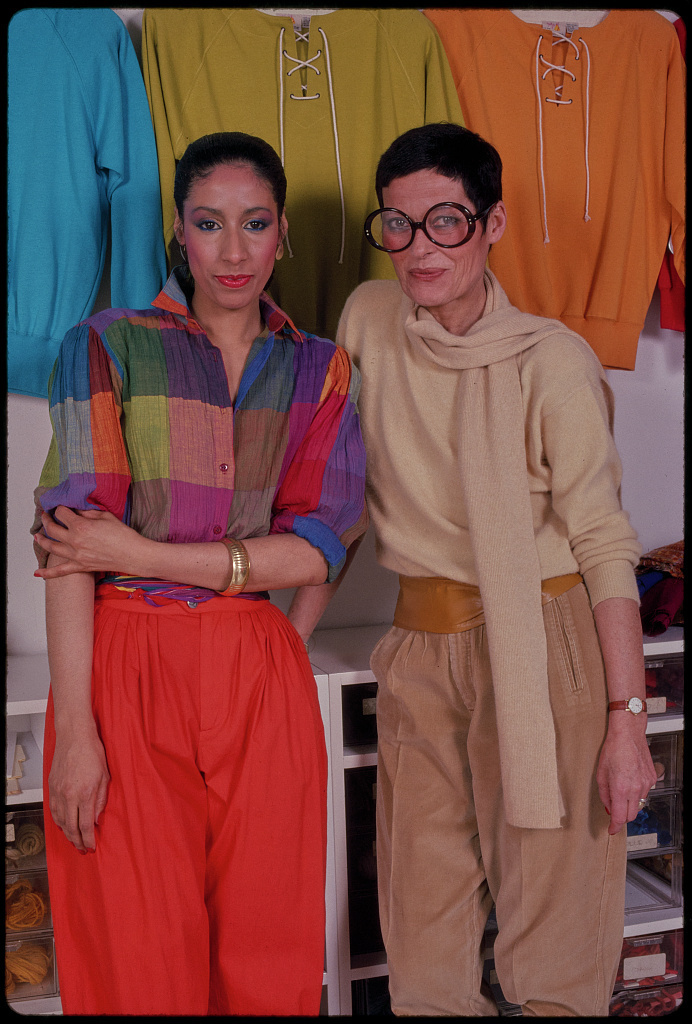
Liz Claiborne, fashion designer, with model
Bernard Gotfryd · 1982 · Photograph
The photograph preserves visible presence; oral history can add narrated context, but neither medium should be treated as a complete account.
Object record and image details
- Collection number
- gtfy.00717
- Credit
- Bernard Gotfryd photograph collection, Library of Congress Prints and Photographs Division
- Image terms
- Free to Use and Reuse / Library of Congress curated set
View the museum record ↗ · Download exhibition image ↓ · View the museum file ↗

COUNTERPOINT
What this framework could get wrong
Oral history can overprivilege charismatic memory, pressure vulnerable narrators, expose third parties, or convert community knowledge into institutional property. Consent and plurality are structural, not decorative.
FIELDWORK
Do the work now
Use this as a working session, not a score.
- Draft a consent and access menu before interview questions.
- Interview founder, practitioner, and operational collaborator separately.
- Return transcripts for correction and preserve disagreement.
- Test whether a successor can retrieve the voice beside the relevant object.
What the sources establish
Fashion oral histories preserve practitioner narration under item-specific rights conditions.
Source note
Directly supported by the linked records.
Oral-history consent, access, privacy, and cultural authority require explicit governance.
Source note
An original working method informed by the linked records.
READ / WATCH / LOOK CLOSER
Continue the story
Project of the Fashion Industries Oral History Series: Bonnie Cashin 1982
FIT Special Collections · 1982-05-26; digitized 2020
Open source ↗Source and use notes
Reference S11
In Copyright; copying, display, or upload requires permission except reviewed fair use.
LINK_ONLY
FIT oral histories collection, 1967–2023
FIT Gladys Marcus Library · 1967–2023
Open source ↗Source and use notes
Reference S15
Finding-aid metadata may be cited; media is governed item by item.
LINK_ONLY
Interview of Christine Pupillo, Leonard Trattner, and Harry Greenberg of the Patternmaking Department
Fashion Institute of Technology Special Collections and College Archives · 1995-02-27; digitized 2020
Open source ↗Source and use notes
Reference S72
In Copyright; FIT prohibits copying, display, or upload without permission except reviewed fair use. Link to the item and do not embed its media.
LINK_ONLY
Joyce A. Bailey Oral History Interview
National Museum of African American History and Culture · 2016-07-11
Open source ↗Source and use notes
Reference S10
Usage Conditions Apply; permission is required for media reuse.
LINK_ONLY
Universal Electronic Records Management Requirements, Version 3
U.S. National Archives and Records Administration · 2023-06
Open source ↗Source and use notes
Reference S39
Government resource; link/download for education and do not imply endorsement.
LINK_ONLY
Personal Digital Archiving
Library of Congress · current; resources include 2013 publication
Open source ↗Source and use notes
Reference S08
Link and quote narrowly; check each downloadable resource before redistribution.
LINK_ONLY
Electronic Records Information for Archivists
U.S. National Archives and Records Administration · current
Open source ↗Source and use notes
Reference S66
Official preservation guidance; paraphrase and link. Federal requirements are not represented as binding on private archives.
LINK_ONLY
THE OBJECTS
Look at the material record
Each object extends the question through a different silhouette, material, function, or moment.
FROM THE COLLECTIONLiz Claiborne, fashion designer, with model
Bernard Gotfryd · 1982 · Photograph
One frame holds a named designer, a model, a photographer, a collection, and an institutional record—separate roles that public shorthand often compresses.
Object record and image details
- Collection number
- gtfy.00717
- Credit
- Bernard Gotfryd photograph collection, Library of Congress Prints and Photographs Division
- Image terms
- Free to Use and Reuse / Library of Congress curated set
- Origin
- Official institution collection record; independently catalogued, not AI-generated.
- Source
- View the museum record ↗
Download exhibition image ↓ · View the museum file ↗ · Download full image notes ↗
FURTHER READING
Archives, records, tools and learning
Personal Digital Archiving
Library of Congress · current; resources include 2013 publication
Open resource ↗Source and use notes
Reference S08
Link and quote narrowly; check each downloadable resource before redistribution.
LINK_ONLY
Joyce A. Bailey Oral History Interview
National Museum of African American History and Culture · 2016-07-11
Open resource ↗Source and use notes
Reference S10
Usage Conditions Apply; permission is required for media reuse.
LINK_ONLY
Project of the Fashion Industries Oral History Series: Bonnie Cashin 1982
FIT Special Collections · 1982-05-26; digitized 2020
Open resource ↗Source and use notes
Reference S11
In Copyright; copying, display, or upload requires permission except reviewed fair use.
LINK_ONLY
FIT oral histories collection, 1967–2023
FIT Gladys Marcus Library · 1967–2023
Open resource ↗Source and use notes
Reference S15
Finding-aid metadata may be cited; media is governed item by item.
LINK_ONLY
Universal Electronic Records Management Requirements, Version 3
U.S. National Archives and Records Administration · 2023-06
Open resource ↗Source and use notes
Reference S39
Government resource; link/download for education and do not imply endorsement.
LINK_ONLY
Electronic Records Information for Archivists
U.S. National Archives and Records Administration · current
Open resource ↗Source and use notes
Reference S66
Official preservation guidance; paraphrase and link. Federal requirements are not represented as binding on private archives.
LINK_ONLY
Interview of Christine Pupillo, Leonard Trattner, and Harry Greenberg of the Patternmaking Department
Fashion Institute of Technology Special Collections and College Archives · 1995-02-27; digitized 2020
Open resource ↗Source and use notes
Reference S72
In Copyright; FIT prohibits copying, display, or upload without permission except reviewed fair use. Link to the item and do not embed its media.
LINK_ONLY
Division of Costume Audiovisual Collection
Smithsonian National Museum of American History Archives Center · collection record current; accessed 2026-09-07
Open resource ↗Source and use notes
Reference X05
Research collection; access and item-level reproduction conditions apply.
LINK_ONLY
Oral history
Museum of Modern Art · program current; accessed 2026-09-07
Open resource ↗Source and use notes
Reference X08
Official program description; recordings and transcripts remain item-specific.
LINK_ONLY
Joyce A. Bailey Oral History Interview
National Museum of African American History and Culture · 2016
Open resource ↗Source and use notes
Reference X09
Exact audiovisual use conditions must be checked; record remains link-only.
LINK_ONLY
Special Collections and FIT Archive
Fashion Institute of Technology · current; accessed 2026-09-07
Open resource ↗Source and use notes
Reference X10
Discovery portal; item-level conditions govern all media.
LINK_ONLY
Personal Digital Archiving
Library of Congress · current; accessed 2026-09-07
Open resource ↗Source and use notes
Reference X36
Official educational resource; link and quote narrowly.
LINK_ONLY
Chinese American fashion designer oral-history digitization project
National Archives and Records Administration · 2024
Open resource ↗Source and use notes
Reference X57
Project description is linkable; interviews and media remain item-specific.
LINK_ONLY
Fashion at the Library
Library of Congress · current; accessed 2026-09-07
Open resource ↗Source and use notes
Reference X60
Discovery channel; each article and asset retains its own rights record.
LINK_ONLY
Research notes for this chapter
Exhaustive within the 18-surface registry and recorded queries; not a claim to every item on the internet.
- Places searched
- 18
- Records considered
- 15
- Images available for use
- 1
- Further-reading links
- 14
Stopped after all 18 named surfaces were queried on 2026-09-07; qualifying records were retained, exact duplicate URLs and assets were removed, every reusable file was checked at work and file level, and remaining no-result surfaces were named. New records or changed rights statements reopen the report.
Download detailed research notes ↓ · Read how the collection was assembled
FOLLOW THE QUESTION
One inquiry, six forms
- Canonical essay: The Oral History Is a Succession Document
- What the file cannot say long-form film
- Ten-frame oral-history governance carousel
- Four voice-archive vertical scripts
- Succession Oral-History Planner
- Beehiiv, LinkedIn, Instagram, Pinterest, audio, and classroom editions
By RN Collins.
Download the chapter ↓ · Download source notes ↓
Practical and professional boundaries
Recorded performance, bespoke RN photography, participant releases, and counsel or specialist review are separate human-led work. They are not represented here as completed recordings, permissions, or professional opinions.
FIND IT ELSEWHERE
Where this dossier lives
How to read the source notes
Material statements link to the records behind them. Interpretation is not presented as source fact. Legal sections identify their jurisdiction; state, foreign, contractual, beneficial-ownership, validity, priority, and disputed-fact questions require appropriate professional review. This exhibition is educational and does not provide legal, conservation, or business advice.