Build · Institutions of One × Fashion
Build study · Instinct → demonstration → shared judgment
Can Taste Become Institutional Knowledge?
Taste becomes institutional knowledge only when people can examine how a judgment was made, practice it, dispute it, preserve its context, and retain authority over what may be carried.
Read the story00
The proposition
Taste is often described as an instinct belonging to one exceptional eye. That description hides the work: looking, comparing, touching, fitting, remembering, rejecting, revising, and learning from skilled collaborators. It also hides unequal access to objects, travel, archives, time, and criticism. An institution should not pretend those conditions are natural talent. It should make the learning pathway and its exclusions visible.
FIT’s patternmaking sources preserve a narrow but useful example of situated professional knowledge: training, slopers, technique, technology, industry practice, and intergenerational experience appear together. UNESCO’s textile safeguarding work adds a crucial boundary—knowledge can belong to practitioners and communities whose consent, benefit, and authority cannot be absorbed into a house manual. Copyright guidance supplies another limit: documenting taste does not make taste itself copyrightable.
01–04
The institutional sequence
01 · ELICIT
What happened before “I just knew”?
Reconstruct the comparison set, sensory cue, memory, technical constraint, cultural reference, commercial condition, and rejected alternative. Record uncertainty and the contributor who supplied each part of the judgment.
Sources behind this section
An interpretation drawn from the linked records.
02 · DEMONSTRATE
Can the judgment be shown in context?
Pair expert demonstration with a learner attempt, correction, second attempt, and commentary on acceptable variation. Some knowledge is tactile, temporal, embodied, confidential, or culturally governed; not everything belongs on camera.
Sources behind this section
An original working method informed by the linked records.
03 · CONTEST
Who can say the founder is wrong?
Create a review ritual where pattern, textile, production, wearer, commercial, cultural, accessibility, and archive perspectives can challenge a choice. Preserve the reason for override rather than manufacturing consensus.
Sources behind this section
An original working method informed by the linked records.
04 · GOVERN
Who may retain and teach it?
Attach consent, compensation, attribution, confidentiality, access, teaching, archive, withdrawal, and cultural-authority fields. Keep protected expression, contract rights, trade secrets, know-how, and abstract taste as separate questions.
Sources behind this section
Directly supported by the linked records.
Look closely
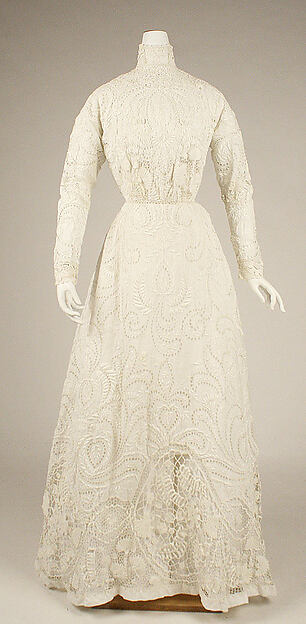
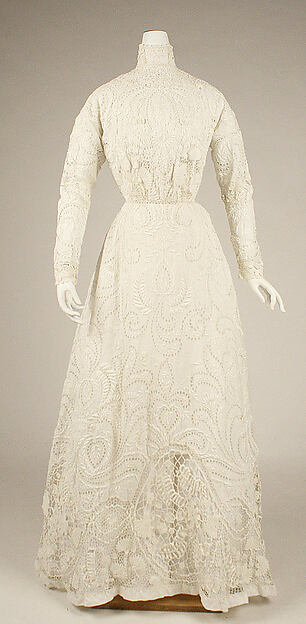
Dress
American or European · ca. 1903 · Linen, cotton
This dress preserves material and construction evidence while its maker remains broadly identified. The record makes visible both what an object can teach and the practiced knowledge and authorship it cannot reconstruct alone.
Object record and image details
- Collection number
- 1976.258.13
- Credit
- Gift of Miss Eva Drexel Dahlgren, 1976
- Image terms
- Public Domain / Met Open Access
View the museum record ↗ · Download exhibition image ↓ · View the museum file ↗
COUNTERPOINT
What this framework could get wrong
Turning taste into institutional knowledge can democratize learning, but it can also extract from workers, communities, and collaborators; privilege what can be verbalized; or make the founder’s preference an unquestionable rule. The system must preserve refusal, disagreement, privacy, and the right not to record.
FIELDWORK
Do the work now
Use this as a working session, not a score.
- Choose one recent judgment and reconstruct every comparison, cue, constraint, contributor, and rejected option.
- With consent, record demonstration, attempt, correction, variation, and stop condition.
- Invite a collaborator to write the strongest disagreement and the conditions under which it should prevail.
- Assign consent, compensation, attribution, access, teaching, archive, and withdrawal authority before preservation.
What the sources establish
FIT preserves practitioner testimony about patternmaking knowledge, training, technique, technology, and industry practice.
Copyright protection for a useful article is limited to qualifying separable pictorial, graphic, or sculptural expression; it does not make taste itself copyrightable.
Institutional taste should preserve dissent, provenance, consent, and revision—not only the founder’s preferred answer.
Source note
An original working method informed by the linked records.
READ / WATCH / LOOK CLOSER
Continue the story
Interview of Christine Pupillo, Leonard Trattner, and Harry Greenberg of the Patternmaking Department
Fashion Institute of Technology Special Collections and College Archives · 1995-02-27; digitized 2020
Open source ↗Source and use notes
Reference S72
In Copyright; FIT prohibits copying, display, or upload without permission except reviewed fair use. Link to the item and do not embed its media.
LINK_ONLY
Patternmaking certificate
Fashion Institute of Technology · current
Open source ↗Source and use notes
Reference S73
Official curriculum description; paraphrase and link. Page media is not treated as open licensed.
LINK_ONLY
Protection for Fashion Design — Statement of the Register of Copyrights
U.S. Copyright Office · 2006-07-27
Open source ↗Source and use notes
Reference S91
Official testimony; quote narrowly and distinguish the historical statement from current law and case-specific advice.
QUOTE_LINK
Useful Articles
U.S. Copyright Office · current; accessed 2026-09-05
Open source ↗Source and use notes
Reference S92
Official registration guidance; paraphrase and link. It does not establish protection for an abstract aesthetic or garment as a whole.
LINK_ONLY
Handmade for the 21st century: safeguarding traditional Indian textiles
UNESCO · 2022
Open source ↗Source and use notes
Reference S88
Official UNESCO publication; summarize and link. Item-level media and community knowledge require separate cultural and rights review.
LINK_ONLY
Garment Industry Compliance Assistance Toolkit
U.S. Department of Labor, Wage and Hour Division · updated 2025-09-23
Open source ↗Source and use notes
Reference S76
Official federal labor resource; paraphrase and link. Do not imply endorsement or that one federal toolkit resolves every employment arrangement.
LINK_ONLY
THE OBJECTS
Look at the material record
Each object extends the question through a different silhouette, material, function, or moment.
FROM THE COLLECTIONDress
American or European · ca. 1903 · Linen, cotton
Construction evidence can outlive the operating house—but only if the physical object and record stay paired.
Object record and image details
- Collection number
- 1976.258.13
- Credit
- Gift of Miss Eva Drexel Dahlgren, 1976
- Image terms
- Public Domain / Met Open Access
- Origin
- Official institution collection record; independently catalogued, not AI-generated.
- Source
- View the museum record ↗
Download exhibition image ↓ · View the museum file ↗ · Download full image notes ↗
 FROM THE COLLECTION
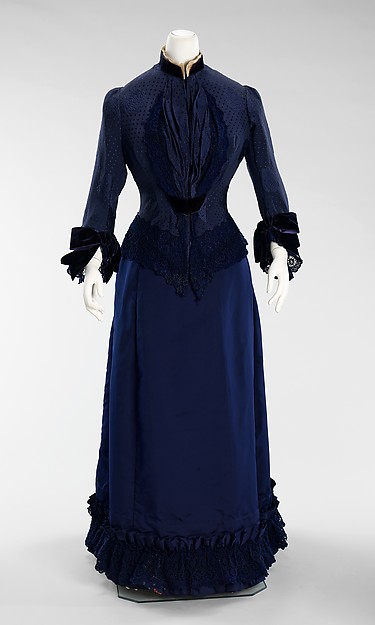
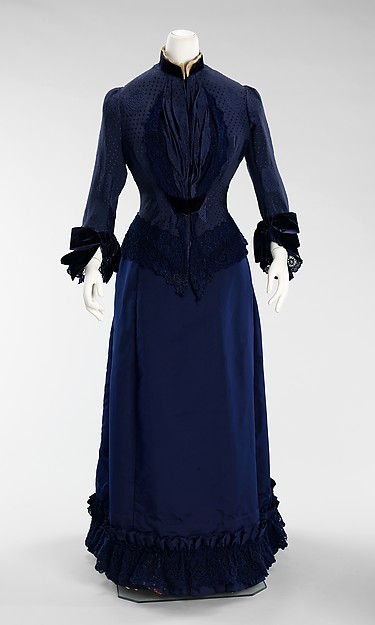
Dress
Maison Pingat · ca. 1885 · Silk, cotton
Maison Pingat survives here through an exact maker record, construction evidence, custody, and an open image—not through fame alone.
Object record and image details
- Collection number
- 2009.300.628a, b
- Credit
- Brooklyn Museum Costume Collection at The Metropolitan Museum of Art; Gift of Lillian E. Glenn Peirce and Mabel Glenn Cooper, 1929
- Image terms
- Public Domain / Met Open Access
- Origin
- Official institution collection record; independently catalogued, not AI-generated.
- Source
- View the museum record ↗
Download exhibition image ↓ · View the museum file ↗ · Download full image notes ↗
FURTHER READING
Archives, records, tools and learning
Interview of Christine Pupillo, Leonard Trattner, and Harry Greenberg of the Patternmaking Department
Fashion Institute of Technology Special Collections and College Archives · 1995-02-27; digitized 2020
Open resource ↗Source and use notes
Reference S72
In Copyright; FIT prohibits copying, display, or upload without permission except reviewed fair use. Link to the item and do not embed its media.
LINK_ONLY
Patternmaking certificate
Fashion Institute of Technology · current
Open resource ↗Source and use notes
Reference S73
Official curriculum description; paraphrase and link. Page media is not treated as open licensed.
LINK_ONLY
Garment Industry Compliance Assistance Toolkit
U.S. Department of Labor, Wage and Hour Division · updated 2025-09-23
Open resource ↗Source and use notes
Reference S76
Official federal labor resource; paraphrase and link. Do not imply endorsement or that one federal toolkit resolves every employment arrangement.
LINK_ONLY
Handmade for the 21st century: safeguarding traditional Indian textiles
UNESCO · 2022
Open resource ↗Source and use notes
Reference S88
Official UNESCO publication; summarize and link. Item-level media and community knowledge require separate cultural and rights review.
LINK_ONLY
Protection for Fashion Design — Statement of the Register of Copyrights
U.S. Copyright Office · 2006-07-27
Open resource ↗Source and use notes
Reference S91
Official testimony; quote narrowly and distinguish the historical statement from current law and case-specific advice.
QUOTE_LINK
Useful Articles
U.S. Copyright Office · current; accessed 2026-09-05
Open resource ↗Source and use notes
Reference S92
Official registration guidance; paraphrase and link. It does not establish protection for an abstract aesthetic or garment as a whole.
LINK_ONLY
Oral history
Museum of Modern Art · program current; accessed 2026-09-07
Open resource ↗Source and use notes
Reference X08
Official program description; recordings and transcripts remain item-specific.
LINK_ONLY
Dive into Color / collection-data experiments
Cooper Hewitt, Smithsonian Design Museum · 2018
Open resource ↗Source and use notes
Reference X12
Link to the documented interactive experiment; code or imagery is not copied without an exact license.
LINK_ONLY
Dress
The Metropolitan Museum of Art · ca. 1885; accessed 2026-09-07
Open resource ↗Source and use notes
Reference X14
Public Domain under Met Open Access; exact image installed separately.
PUBLIC_DOMAIN_CC0
Vestments and how to make them
Library of Congress · 1914
Open resource ↗Source and use notes
Reference X15
Library of Congress item identifies the work as free to use and reuse.
LINK_ONLY
Shelter and clothing
Library of Congress · 1913
Open resource ↗Source and use notes
Reference X16
Library of Congress item identifies the work as free to use and reuse.
LINK_ONLY
A system for cutting ladies garments
Library of Congress · 1917
Open resource ↗Source and use notes
Reference X17
Library of Congress item identifies the work as free to use and reuse.
LINK_ONLY
Cooper Hewitt Collection API
Cooper Hewitt · current; accessed 2026-09-07
Open resource ↗Source and use notes
Reference X25
Link to official API; individual collection objects retain their stated rights.
LINK_ONLY
Dressmaking
Internet Archive · 1917
Open resource ↗Source and use notes
Reference X43
Work-level public-domain-era candidate; Internet Archive availability alone is not file-level permission, so linked pending scan-source verification.
LINK_ONLY
Pattern making
Internet Archive · 1922
Open resource ↗Source and use notes
Reference X44
Work-level public-domain-era candidate; file provenance requires item review before local ingest.
LINK_ONLY
Complete course in dressmaking: Draping and Pattern Making
Internet Archive · 1922
Open resource ↗Source and use notes
Reference X45
Linked at work level; the exact derivative file and scan-source rights were not independently cleared for redistribution.
LINK_ONLY
Drafting trousers for men, boys, women
Internet Archive · 1945
Open resource ↗Source and use notes
Reference X46
Item page displays Public Domain Mark 1.0; retained as a canonical resource rather than duplicating its derivative files.
LINK_ONLY
The Keystone jacket and dress cutter
Internet Archive · 1895
Open resource ↗Source and use notes
Reference X47
Public-domain-era work; linked pending exact derivative-file provenance verification.
LINK_ONLY
Secrets of Balenciaga’s construction
Victoria and Albert Museum · 2023; accessed 2026-09-07
Open resource ↗Source and use notes
Reference X48
Protected museum text and media; use the first-party page/player only.
AUTHORIZED_EMBED
Learning from “The Master”
Victoria and Albert Museum · 2023; accessed 2026-09-07
Open resource ↗Source and use notes
Reference X49
Protected first-party media; link or authorized player only.
AUTHORIZED_EMBED
Sew your own: kimono-inspired dress
Victoria and Albert Museum · 2023; accessed 2026-09-07
Open resource ↗Source and use notes
Reference X50
First-party educational page; patterns and page media remain under their stated site conditions.
LINK_ONLY
Research notes for this chapter
Exhaustive within the 18-surface registry and recorded queries; not a claim to every item on the internet.
- Places searched
- 18
- Records considered
- 23
- Images available for use
- 3
- Further-reading links
- 20
Stopped after all 18 named surfaces were queried on 2026-09-07; qualifying records were retained, exact duplicate URLs and assets were removed, every reusable file was checked at work and file level, and remaining no-result surfaces were named. New records or changed rights statements reopen the report.
Download detailed research notes ↓ · Read how the collection was assembled
FOLLOW THE QUESTION
One inquiry, six forms
- Canonical essay: The Institution Inside the Eye
- Ten-minute demonstration-and-correction film
- Eight-frame taste-is-a-process carousel
- Four tacit-judgment vertical scripts
- Taste Transmission Protocol
- Newsletter, oral-history, and workshop editions
By RN Collins.
Download the chapter ↓ · Download source notes ↓
Practical and professional boundaries
Recorded performance, bespoke RN photography, participant releases, and counsel or specialist review are separate human-led work. They are not represented here as completed recordings, permissions, or professional opinions.
FIND IT ELSEWHERE
Where this dossier lives
How to read the source notes
Material statements link to the records behind them. Interpretation is not presented as source fact. Legal sections identify their jurisdiction; state, foreign, contractual, beneficial-ownership, validity, priority, and disputed-fact questions require appropriate professional review. This exhibition is educational and does not provide legal, conservation, or business advice.