Build · Institutions of One × Fashion
Build study · Look → workflow → feedback loop
When Does an Aesthetic Become a System?
An aesthetic becomes a system when recurring choices are connected to roles, evidence, tests, handoffs, exceptions, and feedback—so the practice can learn without reducing itself to visual sameness.
Read the story00
The proposition
Aesthetic is often used as a cloud of references: colors, screenshots, icons, eras, bodies, places. A system asks harder questions. Who selects? Which decision arrives first? What changes after fitting? Which material forces a new proportion? Who can reject the image? Where does audience response enter—and where must it not overrule the work? The shift is from appearance to accountable sequence.
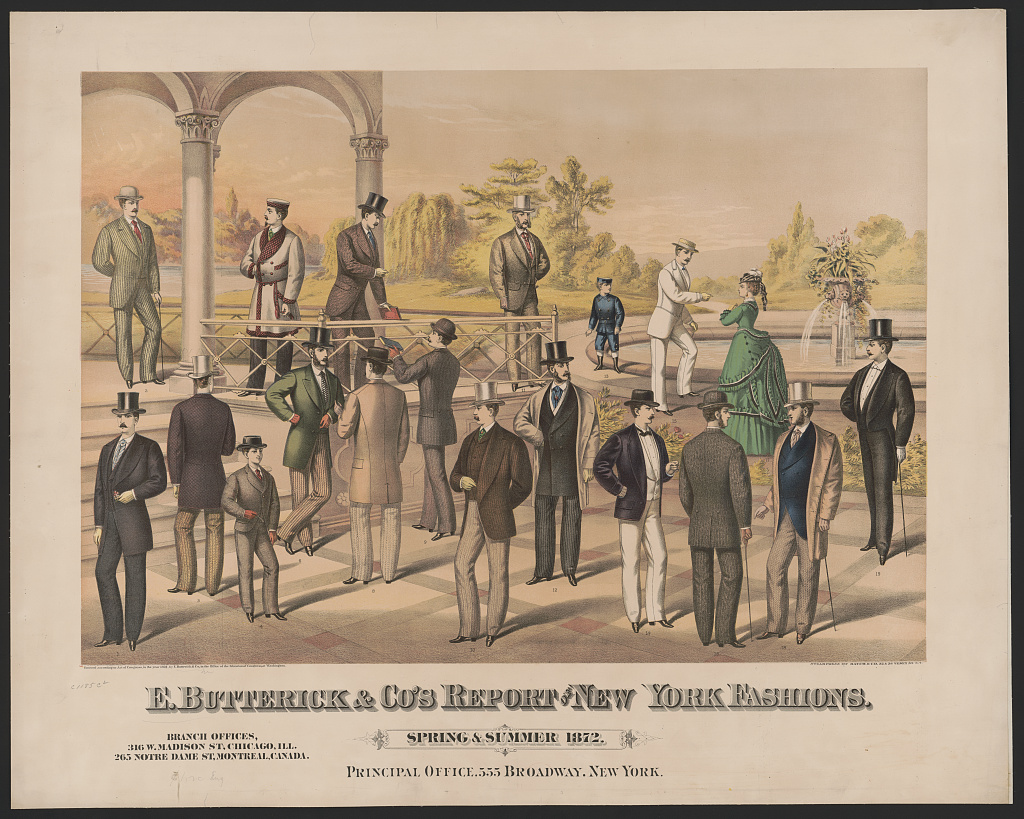
The Library of Congress Butterick sheet is useful because it survives as more than an attractive plate: it has a creator context, date, identifier, repository, and reuse pathway. Yet the image cannot reveal the full production and distribution system behind it. That gap demonstrates the editorial method. Visual evidence can anchor an inquiry, but the institution must reconstruct roles, records, decisions, rights, and feedback without inventing what the object cannot prove.
01–04
The institutional sequence
01 · INPUT
What enters the aesthetic system?
Inventory references, materials, bodies, techniques, constraints, memories, commissions, budgets, deadlines, collaborators, and cultural knowledge. Attach origin, permission, credit, context, and transformation status to every consequential input.
Sources behind this section
An original working method informed by the linked records.
02 · RULE
How does an input change a decision?
Translate a mood into a testable relation: if the material has this weight, the silhouette permits this movement; if the image uses this distance, the body retains this agency. Preserve exceptions and who may authorize them.
Sources behind this section
An interpretation drawn from the linked records.
03 · LOOP
How does the system learn?
Connect sample, fitting, wearer response, production constraint, image review, sales signal, repair evidence, criticism, and archive return. Record which feedback changed the work and which was rejected with reason.
Sources behind this section
An original working method informed by the linked records.
04 · RIGHTS
Which outputs or identifiers may be protected?
Map exact works, marks, registrations, contracts, designs, files, and confidential methods separately. Do not convert system documentation into a claim that the overall aesthetic is automatically copyrighted or registrable.
Sources behind this section
Directly supported by the linked records.
Look closely
Report of New York fashions, spring and summer 1872
Butterick & Co. · 1872 · Advertisement lithograph
The Butterick sheet is a visual and commercial output with a durable record. It prompts reconstruction of the hidden design, printing, pattern, advertising, and distribution system without pretending the plate contains those agreements.
Object record and image details
- Collection number
- ppmsca.44953
- Credit
- Library of Congress Prints and Photographs Division
- Image terms
- Free to Use and Reuse / Library of Congress curated set
View the museum record ↗ · Download exhibition image ↓ · View the museum file ↗

COUNTERPOINT
What this framework could get wrong
Systems can make work scalable and reviewable; they can also become bureaucracy, optimize toward what platforms reward, and harden a founder’s bias into process. A healthy aesthetic system includes exit ramps, minority reports, ethical review, and protected zones for experiment that do not need immediate justification.
FIELDWORK
Do the work now
Use this as a working session, not a score.
- Map one look from reference and material through fitting, image, audience, repair, and archive.
- At each handoff, name the person, decision, evidence, version, and return path.
- Write three rules as relationships, then attach an exception and override authority to each.
- Audit which exact outputs have rights records and which broad aesthetic claims must remain cultural interpretation.
What the sources establish
The Butterick fashion sheet survives as a named commercial and visual record with a stable Library of Congress identifier.
Product-design trade dress and copyright in artistic features of useful articles are distinct, fact-specific doctrines.
An aesthetic becomes an operating system when roles, tests, records, feedback, and exceptions can reproduce judgment without requiring visual sameness.
Source note
An interpretation drawn from the linked records.
READ / WATCH / LOOK CLOSER
Continue the story
Report of New York fashions, spring & summer 1872
Library of Congress · 1872
Open source ↗Source and use notes
Reference S61
Included in the Library of Congress Fashion Free to Use and Reuse set; retain Butterick & Co. context, identifier, and canonical record.
REUSE
Fashion — Free to Use and Reuse
Library of Congress · collection current; accessed 2026-09-04
Open source ↗Source and use notes
Reference S90
The curated set provides reuse context; the exact item record and any item-specific advisory remain controlling.
REUSE_ITEM_CHECK
Useful Articles
U.S. Copyright Office · current; accessed 2026-09-05
Open source ↗Source and use notes
Reference S92
Official registration guidance; paraphrase and link. It does not establish protection for an abstract aesthetic or garment as a whole.
LINK_ONLY
Trademark Manual of Examining Procedure §1202.02 — Registration of Trade Dress
U.S. Patent and Trademark Office · current edition; accessed 2026-09-05
Open source ↗Source and use notes
Reference S93
Official examination guidance; paraphrase and link. Product-design trade dress requires fact-specific legal analysis.
LINK_ONLY
Interview of Christine Pupillo, Leonard Trattner, and Harry Greenberg of the Patternmaking Department
Fashion Institute of Technology Special Collections and College Archives · 1995-02-27; digitized 2020
Open source ↗Source and use notes
Reference S72
In Copyright; FIT prohibits copying, display, or upload without permission except reviewed fair use. Link to the item and do not embed its media.
LINK_ONLY
Patternmaking certificate
Fashion Institute of Technology · current
Open source ↗Source and use notes
Reference S73
Official curriculum description; paraphrase and link. Page media is not treated as open licensed.
LINK_ONLY
Rights and Access — Toni Frissell Collection
Library of Congress · collection guidance current; accessed 2026-09-05
Open source ↗Source and use notes
Reference S97
Official collection-level rights advisory; exact item records and any restrictions remain controlling.
LINK_ONLY
Garment Industry Compliance Assistance Toolkit
U.S. Department of Labor, Wage and Hour Division · updated 2025-09-23
Open source ↗Source and use notes
Reference S76
Official federal labor resource; paraphrase and link. Do not imply endorsement or that one federal toolkit resolves every employment arrangement.
LINK_ONLY
Protection for Fashion Design — Statement of the Register of Copyrights
U.S. Copyright Office · 2006-07-27
Open source ↗Source and use notes
Reference S91
Official testimony; quote narrowly and distinguish the historical statement from current law and case-specific advice.
QUOTE_LINK
THE OBJECTS
Look at the material record
Each object extends the question through a different silhouette, material, function, or moment.
FROM THE COLLECTIONReport of New York fashions, spring and summer 1872
Butterick & Co. · 1872 · Advertisement lithograph
The sheet demonstrates a contract-shaped network of design, printing, manufacture, advertising, attribution, and distribution—even when the operative agreements are absent from the image.
Object record and image details
- Collection number
- ppmsca.44953
- Credit
- Library of Congress Prints and Photographs Division
- Image terms
- Free to Use and Reuse / Library of Congress curated set
- Origin
- Official institution collection record; independently catalogued, not AI-generated.
- Source
- View the museum record ↗
Download exhibition image ↓ · View the museum file ↗ · Download full image notes ↗
FURTHER READING
Archives, records, tools and learning
Report of New York fashions, spring & summer 1872
Library of Congress · 1872
Open resource ↗Source and use notes
Reference S61
Included in the Library of Congress Fashion Free to Use and Reuse set; retain Butterick & Co. context, identifier, and canonical record.
REUSE
Interview of Christine Pupillo, Leonard Trattner, and Harry Greenberg of the Patternmaking Department
Fashion Institute of Technology Special Collections and College Archives · 1995-02-27; digitized 2020
Open resource ↗Source and use notes
Reference S72
In Copyright; FIT prohibits copying, display, or upload without permission except reviewed fair use. Link to the item and do not embed its media.
LINK_ONLY
Patternmaking certificate
Fashion Institute of Technology · current
Open resource ↗Source and use notes
Reference S73
Official curriculum description; paraphrase and link. Page media is not treated as open licensed.
LINK_ONLY
Garment Industry Compliance Assistance Toolkit
U.S. Department of Labor, Wage and Hour Division · updated 2025-09-23
Open resource ↗Source and use notes
Reference S76
Official federal labor resource; paraphrase and link. Do not imply endorsement or that one federal toolkit resolves every employment arrangement.
LINK_ONLY
Fashion — Free to Use and Reuse
Library of Congress · collection current; accessed 2026-09-04
Open resource ↗Source and use notes
Reference S90
The curated set provides reuse context; the exact item record and any item-specific advisory remain controlling.
REUSE_ITEM_CHECK
Protection for Fashion Design — Statement of the Register of Copyrights
U.S. Copyright Office · 2006-07-27
Open resource ↗Source and use notes
Reference S91
Official testimony; quote narrowly and distinguish the historical statement from current law and case-specific advice.
QUOTE_LINK
Useful Articles
U.S. Copyright Office · current; accessed 2026-09-05
Open resource ↗Source and use notes
Reference S92
Official registration guidance; paraphrase and link. It does not establish protection for an abstract aesthetic or garment as a whole.
LINK_ONLY
Trademark Manual of Examining Procedure §1202.02 — Registration of Trade Dress
U.S. Patent and Trademark Office · current edition; accessed 2026-09-05
Open resource ↗Source and use notes
Reference S93
Official examination guidance; paraphrase and link. Product-design trade dress requires fact-specific legal analysis.
LINK_ONLY
Rights and Access — Toni Frissell Collection
Library of Congress · collection guidance current; accessed 2026-09-05
Open resource ↗Source and use notes
Reference S97
Official collection-level rights advisory; exact item records and any restrictions remain controlling.
LINK_ONLY
Diana Dew's Designs
National Museum of American History · record accessed 2026-09-07
Open resource ↗Source and use notes
Reference X04
Search result indicates CC0 media; direct asset could not be independently retrieved in this environment, so the object remains link-only.
LINK_ONLY
Dive into Color / collection-data experiments
Cooper Hewitt, Smithsonian Design Museum · 2018
Open resource ↗Source and use notes
Reference X12
Link to the documented interactive experiment; code or imagery is not copied without an exact license.
LINK_ONLY
Vestments and how to make them
Library of Congress · 1914
Open resource ↗Source and use notes
Reference X15
Library of Congress item identifies the work as free to use and reuse.
LINK_ONLY
A system for cutting ladies garments
Library of Congress · 1917
Open resource ↗Source and use notes
Reference X17
Library of Congress item identifies the work as free to use and reuse.
LINK_ONLY
Costume design for a New York production
Library of Congress · 1935–1939
Open resource ↗Source and use notes
Reference X18
Library of Congress item is in a free-to-use collection; exact record governs.
LINK_ONLY
Dressmaking
Internet Archive · 1917
Open resource ↗Source and use notes
Reference X43
Work-level public-domain-era candidate; Internet Archive availability alone is not file-level permission, so linked pending scan-source verification.
LINK_ONLY
Pattern making
Internet Archive · 1922
Open resource ↗Source and use notes
Reference X44
Work-level public-domain-era candidate; file provenance requires item review before local ingest.
LINK_ONLY
Complete course in dressmaking: Draping and Pattern Making
Internet Archive · 1922
Open resource ↗Source and use notes
Reference X45
Linked at work level; the exact derivative file and scan-source rights were not independently cleared for redistribution.
LINK_ONLY
The Keystone jacket and dress cutter
Internet Archive · 1895
Open resource ↗Source and use notes
Reference X47
Public-domain-era work; linked pending exact derivative-file provenance verification.
LINK_ONLY
Secrets of Balenciaga’s construction
Victoria and Albert Museum · 2023; accessed 2026-09-07
Open resource ↗Source and use notes
Reference X48
Protected museum text and media; use the first-party page/player only.
AUTHORIZED_EMBED
Research notes for this chapter
Exhaustive within the 18-surface registry and recorded queries; not a claim to every item on the internet.
- Places searched
- 18
- Records considered
- 20
- Images available for use
- 2
- Further-reading links
- 18
Stopped after all 18 named surfaces were queried on 2026-09-07; qualifying records were retained, exact duplicate URLs and assets were removed, every reusable file was checked at work and file level, and remaining no-result surfaces were named. New records or changed rights statements reopen the report.
Download detailed research notes ↓ · Read how the collection was assembled
FOLLOW THE QUESTION
One inquiry, six forms
- Canonical essay: From Moodboard to Feedback Loop
- Fourteen-minute one-look systems film
- Twelve-frame aesthetic-is-a-workflow carousel
- Five system-versus-style vertical scripts
- Aesthetic Operating Loop
- Newsletter, studio, and curriculum editions
By RN Collins.
Download the chapter ↓ · Download source notes ↓
Practical and professional boundaries
Recorded performance, bespoke RN photography, participant releases, and counsel or specialist review are separate human-led work. They are not represented here as completed recordings, permissions, or professional opinions.
FIND IT ELSEWHERE
Where this dossier lives
How to read the source notes
Material statements link to the records behind them. Interpretation is not presented as source fact. Legal sections identify their jurisdiction; state, foreign, contractual, beneficial-ownership, validity, priority, and disputed-fact questions require appropriate professional review. This exhibition is educational and does not provide legal, conservation, or business advice.